Types of Cocoa Bean Roasters

Chocolate making factory worker putting cocoa beans in a roaster

Roasting Cocoa Part III

It is not hard to imagine that once in an Olmec village in Central America some cocoa beans were accidentally spilled near the fire, or some genius had the spark of inspiration to roast cocoa beans, an oversight that sent their culture and eventually the rest of the world on the chocolate journey that consumes us like the spark of the fire from that very first roast. In either case, the first cocoa beans were probably roasted on rocks alongside the fire, on a rock slab over the fire, or possibly in a clay pot. Whatever the original method of roasting, it created a legacy that lasts until today.

When cocoa beans were first brought to Europe, the method of roasting was quite simple, often consisting of no more than metal trays suspended by chains over a fire, an ancient Middle Eastern technique for roasting coffee. The beans would be stirred by hand with a long stick or paddle until the roast was complete. Needless to day, this was very labor intensive and inefficient. Clearly, something more efficient was needed.

The next development in roasting technology was not that far distant from roasters in use today. Metal cylinders or balls that could hold up to several pounds of cocoa beans would be suspended over the embers of a fire. A rod would run through the center and act as an axis upon which the roaster would turn. A hand crank on one end would allow the cylinder or ball to be turned while the beans were roasting. The result was a much more even roast than was before possible. Aspects of this technique remain in many of today’s roasters.

Ball Roasters

As mentioned, all roasters were one of the very first kinds of roaster: balls were simply suspended simply over a fire, the cocoa beans inside. Ball roasters remained one of the primary and traditional roasters for cocoa beans through the turn of the century and were constructed at least through the 1960’s. Later designs were pioneered by the company Sirocco. (Sirocco is named after the hot wind that travels up from the Sahara desert and heads north and may reach hurricane speeds by the time it reaches northern Africa, Spain and France.) The ball is encircled within a secondary chamber so that the hot air passes in between the ball and the outer chamber wall. This prevents the flames from impinging directly on the ball and makes it easier to over roast the beans.

Today, ball roasters have been largely replaced by roasters of similar design that use a rotating cylinder rather than a rotating ball. There are a number of practical advantages of this design, since the shape of a cylinder with two ends makes it easier for samples to be removed. It also allows for easier measurement of the temperature of the beans if automation is a requirement. Ball roasters still hold advantage when flavor is of paramount importance.

Fluid Bed Roasters

Fluid bed roasters are a relatively new development. There are a number of different designs, some of them radically different. What they all have in common is that air is blown up through the beans, suspending them at least temporarily in air. The bottom of the roaster may vibrate to help launch the beans into the air. Fluid-bed roasters are typically used in large industrial environments, since they are conducive to short, high-temperature roasting that allows large volumes of beans to be roasted in a short period of time.

Continuous Roasters

The large chocolate manufacturers rely on continuous roasters. Given the quantity of beans that must be roasted for a large industrial chocolate manufacturer and the relatively low prices of industrial chocolate, they are probably one of the only economical ways to roast the large quantity of beans that must be roasted.

There are many different styles of continuous roaster, though in general they fall into two different categories. In one style, the beans are passed on a conveyer belt through a roasting tunnel. The degree of roast can be controlled by controlling the temperature in the tunnel as well as the speed of the conveyer belt. The heat is applied to the beans in a consistent way throughout the roasting process. Alternatively, another style uses a tall tower into which the beans are fed into the top. The tower has a series of trays upon which the beans rest. Once the beans have roasted on one tray for a given period of time, they are dumped onto the next tray. By the time the beans reach the bottom of the tower, they are fully roasted. The airflow through the tower is from the bottom up. The beans cool the air as the air passes them, at the same time heating the beans. This means that the beans on the lower levels are heated faster than those at the top. Because of this, they will generate a different flavor profile in the finished chocolate. It should be pointed out that there are also continuous fluid-bed roasters.

One disadvantage of this kind of roaster is that it is relatively difficult to pull samples of the beans from the roaster while they are being roasted. Furthermore, if the beans are found to be properly roasted when they are only partially through the roaster, there is no way to quickly remove them from the roaster and get them into a cooler. On the other hand, the large industrial chocolate makers run such large quantities of beans, this process can be fine tuned for a particular type of bean. Furthermore, most of these manufacturers use Forestero beans almost exclusively, for which the degree of roast is not as critical as it is with Criollo and other types of high-grade flavor beans.

Cocoa Mass Roasters

These have already been discussed, but to recap, cocoa mass roasters are basically tanks in which the ground cocoa bean paste (cocoa mass) is heated as it is stirred until the desired level of roast is reached. It may also be implemented as a large heated cylinder where the cocoa mass is spread in a thin film. Since the film is thin, it roasts very quickly, and a thin knife blade scrapes it off of the far side of the cylinder. Cocoa-mass roasters are used by the large industrial chocolate manufacturers as a way to quickly roast large quantities of cocoa beans with minimal labor, since it is also a process that by nature requires little labor, and it also lends itself to easy automation.
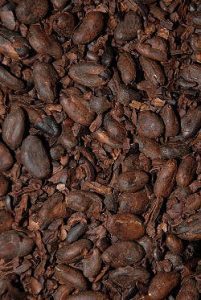
Roasted Coco Beans
The Conclusion — Roasted Cocoa Beans. (Venezuelan Cuyagua)

We won’t get into the many other roasting technologies, such as infrared and microwave. There are even combinations of the various kinds, such as continuous fluid bed roasters. No matter the technology, the best roaster is the one best suited to the job. With poor quality beans, cocoa mass roasters and continuous roasters, or even coffee roasters, will often suffice, since the beans’ flavors are already considerably damaged; no matter the care, the lost flavors may not be brought back. However, if fine flavor is to be developed in the finished chocolate, the choice of roaster is much more critical, as are the techniques used to roast the cocoa beans. Different beans and different styles of chocolate have different roasting requirements, so care must be taken to select the roaster that will best bring the final result, be it high production quantity, as is the case for the large industrial manufacturers, or fine flavor for the artisanal chocolate makers.

Conclusion

Roasting truly is one of the chocolate maker’s arts. It takes a fine flavor palate to be able to judge a roast and judge how the roasted cocoa bean will taste when it is turned into fine chocolate. An incredible number of flavor changes occur during the time the cocoa beans are roasted. Even after the chocolate is complete—even as the chocolate is “resting” and undergoing its final stages of flavor development—the flavors continue to change. The resting process continues oftentimes for several months. The chocolate maker who seeks for optimal flavor must not only think about the flavor of the bean as it is being roasted but must think about how the flavors will change as the chocolate is being made and how the chocolate will taste after it has rested. The flavors will be radically different, and new flavor profiles will often express themselves. Roasting is a bit of a secret art. There are no guidelines on how the best cocoa roasts are to be obtained. It must be learned through experience and through many tests and trials—many of which result in failure. However, this is the case with most all great artistic skills, and the cocoa bean roaster is truly an artist—an artist in flavor. The roaster is an artist who uses one of the world’s greatest sources of flavor and noblest of ingredients—the cocoa bean, also known as “the food of the gods.”

Cocoa Fermentation — All About It: Part 1

Close-up of cocoa beans fermenting in wooden boxes with steam rising, set against a backdrop of lush green foliage

Cocoa Fermentation — Bringing Magic to the Cocoa

After the farmers have harvested the cocoa pods from the tree, some of the most crucial work begins to make fine, high-grade chocolate. The beans must be carefully fermented to bring out the very best flavors. It is unfortunate that the process of proper fermentation is under-appreciated both by the public and the farmer alike. However, to the artisanal chocolatier, proper cocoa fermentation is critically important. Chocolate made from unfermented cocoa beans does not have the body and richness as chocolate made from fermented cocoa beans. Chocolate does continue to be made from unfermented beans in parts of Mexico and Central America for use in traditional dishes. Cocoa fermentation also helps remove the tannins present in the cacao bean. Depending on the study, the amount of tannins in each bean is between five and fifteen percent of the bean by weight. Tannins bring an astringent flavor to the final chocolate and must be removed. Other compounds within the cocoa bean also detract from the taste of the final chocolate that proper fermentation also helps to remove. While roasting and conching helps remove the tannins through oxidation and other processes, the fewer tannins that are in the bean to begin with, the easier it is for the chocolatier to achieve an optimal flavor profile. Rather than having to be concerned with how to best remove the tannins — processes that may hurt the end-flavor profile — the chocolatier is able to concentrate more fully on bringing out the optimal flavors from beans to make the best chocolate possible. Unfortunately, the farmer is in most cases not a chocolate maker. Because of this, many farmers perform the cocoa fermentation only because that is what the market demands without fully understanding what improper cocoa fermentation does to the final chocolate or what wonders proper fermentation may bring. The problem is compounded by the mass-market chocolate companies that purchase the beans without particular regard to the degree of cocoa fermentation or even how consistently fermented the beans are. Of course, at Amano Artisan Chocolate, we are careful to work with our growers to ensure that the optimal fermentation is performed on all the beans we buy.

The Cocoa Fermentation Begins

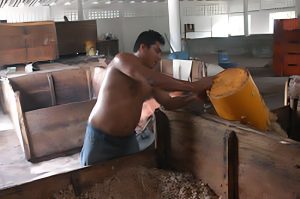
A cocoa farmer moving fermenting cacao beans from one cocoa fermentation box to another

Each cacao pod holds approximately 40 beans, and they must be carefully removed from the pods to ensure that the beans are not injured in the process. Some farmers will use machetes to open the pods, but this can damage the beans and causes quality problems in the product during fermentation and roasting. Farmers who are more careful will quickly rap the cocoa pod on a rock or tree, and the pod will quickly and easily break open, allowing the beans to be scooped out without damage. When they are first removed from the pod, the beans have a white, mucilage-like coating around each bean. It is sweet and yet tart. It’s a bit like a very sweet lemon and is incredibly refreshing on a hot tropical day. This coating provides a food source for the bean as it germinates. It also provides the sugar needed as the basis for the fermentation process that each bean will undergo. The beans are scooped out of the pods and then collected together for fermenting in one or more cocoa fermentation boxes or “sweatboxes.” The sweatboxes used for cocoa fermentation may be located at the plantation or may be located at the local co-op, where the beans are mixed with beans from other local farms during and after fermentation. No matter the location of the sweatboxes, it is important that this happen as quickly as possible, since the beans begin to germinate as soon as the fruit has been picked. If the germination process is allowed to progress too far, the beans will turn bitter, and the bitterness cannot be removed with further processing. As with most organic material, fermentation begins almost immediately upon exposure to air. Cocoa fermentation is no different. Spores from naturally occurring yeasts (Saccharomyces) settle on the sugary beans and start to split the sugar into alcohol and carbon dioxide. The alcohol is split further into acetic acid by the same bacteria that are responsible for turning wine into vinegar, the Mycoderma aceti. The chocolate maker must later remove the acetic acid that is generated through cocoa fermentation.

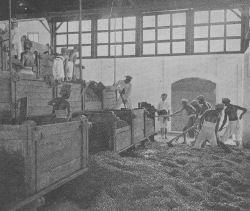
Historical black-and-white photo of workers fermenting cocoa beans in a large indoor facility with wooden fermentation boxes, large windows, and scattered beans on the floor.
Stepped cocoa fermentation boxes in Java circa 1900

The fermentation’s chemical changes occur both outside and inside the bean. The sweet mucilage-like coating on each bean spurs the fermentation that takes place outside the bean. Given the incredible amount of fermentation going on, the temperature rises quickly. In fact, during the cocoa’s fermentation temperatures can climb to 122F (48 C), so hot that if you were to put your hand into the sticky gooey mass of beans, you would not be able to leave it there for very long. On the second day of fermentation, the temperature reaches 113F (43 C), where the germ within the cacao bean dies from the heat, alcohol, and acetic acid. When the germ dies, important chemical changes begin as enzymes within the bean itself are released. These are important to the development of the chocolate flavor. The beans must also be rotated within the sweatboxes. This is normally done by transferring the beans from one sweatbox to another. In the process, if they are rotated too frequently, they will get too much oxygen, and the beans will become too hot and develop dark spots. On the other hand, if they are rotated too infrequently, the cocoa beans will ferment inconsistently, since the beans in the interior of the sweatbox will get less oxygen than those on the sides. As with most things, to get it just right requires an artist’s skill.

Cocoa Fermentation — All About It: Part 2

Cocoa beans fermenting in wooden boxes lined with green banana leaves, with steam rising in a lush, tropical environment.

Cocoa Fermentation Sweatboxes

Overtime a number of different types of  cocoa fermentation boxes or “sweatboxes” have been used for cocoa fermentation. Thankfully, the techniques for building them continue to improve as do the techniques used to get a consistent fermentation.

Just a Hole in the Ground

One of the most traditional methods used up through the beginning of the 1900s to ferment the cocoa beans was simply to dig a small hole and place the beans in it. The beans were then covered with banana leaves to trap the heat generated by fermentation. Thankfully, this process is not used today to any great degree. The results were inconsistently fermented beans; and the mucilage coating liquefied and pooled instead of draining as it fermented, causing additional quality problems.

Wooden Canoe

Well, it isn’t a real canoe but it looks like one. With this type of sweatbox, the beans are stacked into what looks to be a wooden dugout canoe. Unlike a canoe, though, there are small holes in the bottom through which the white mucilage coating can drain as the beans ferment. The cocoa beans are covered with banana leaves or a similar coating to help keep the heat in. Periodically, the beans are stirred with long wooden stirring poles. Not many of these remain, and this method of fermentation is disappearing. It would not be surprising if this technique traced its way back to the Mayans or Olmecs.

Stacked Sweatboxes

Antique Stepped cocoa fermentation boxes.

One of the earliest “industrial” techniques of fermenting cacao is to build a set of boxes, each box set on top and to the side of the next, creating in effect a set of stairs. Holes in the bottom allow for drainage as well as air circulation. The fermenting starts with the beans being hauled up and emptied into the boxes on the top level. As the cocoa bean fermentation continues, the beans are removed from the bottom box and then dried. The beans in the next higher box are shoveled into the bottom box, this turned and aerated them. The process continues up to the top box where new beans are then added. This happens once or twice a day depending on what the fermenting requirements are.

Modern Sweatboxes

New Fermentation Boxes align in row
New Fermentation Boxes

Today, boxes about four feet square and four feet tall are built out of a wood that is conducive to fermentation. (The wood of choice is red cedar.) Each box contains approximately one ton of beans. As with the stacked sweatboxes, holes in the bottom allow for aeration and drainage. The beans are shoveled from one box to the next with either wooden shovels or buckets. Long sticks are used to break up any clumps of beans and ensure that the beans are free flowing and are able to get plenty of air while they are fermenting.

In a common variation of this that often occurs at the co-op level, the boxes are fitted with steel frames. These allow for the boxes to be lifted into the air by an overhead hoist and then emptied into the next box. The dumping action breaks up the clumps of beans and allows fresh air to enter into the mix. The process of dumping one sweatbox into the next continues until the proper level of fermentation is reached.

Fermentation Times

The amount of time that the beans are fermented depends heavily on the type of bean. Criollo beans need a shorter amount of fermentation than do Forestero beans. This has much to do with Criollo’s naturally milder flavor; not as much fermentation is needed to cut their harshness, compared to the harsher varieties of cacao. Fermentation times from five to seven days are typical.

When the fermentation is complete, the cocoa beans must be removed from the sweat boxes and carefully dried.

Consistency is a Virtue

No matter how the fermentation is performed, the key is consistency. The beans need to be fermented as perfectly as they can as well as be as consistently fermented as possible. While this task may seem easy, in fact it is very difficult. The farmers deal with literally tons of beans, and that makes stirring, fermenting, and processing consistently very difficult. It can be done, however. There are three classes of farms or co-ops. Some have poor quality beans but are able to ferment them well, some have good quality beans but are incapable of fermenting them in a suitable way. If a chocolate manufacturer is capable of finding a farm or co-op where the nexus of these come together such that they not only have good beans but also are capable of fermenting them in a way that does justice to these small jewels, then the chocolate manufacturer has truly found a prize from which great chocolate may be made.

Needless to say, at Amano Artisan Chocolate, we scour the world for the few places where these nexuses exist. They are few and far between, and we have to look very hard to find them, but we believe that the chocolate that comes from these few sources is well worth it.