How Much Caffeine is in Chocolate?

A diagram of caffeine with coffee and dark, milk, and white chocolate bars.

People often ask us, “Does chocolate have caffeine?” and if so, “How much caffeine is in chocolate?” For the record, chocolate contains small amounts of caffeine. Chocolate also contains another closely related substance called theobromine in much larger levels, and the presence of these two closely related substances has been the cause of much confusion among chocolate lovers.
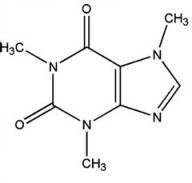
Caffeine Molecule

Caffeine is a xanthine alkaloid substance that is found in the leaves, fruits and nuts of a variety of different plants, including coffee, guarana, tea, yerba mate, and approximately 60 other plants. Amazingly, caffeine is found in a wide variety of types of plants and on completely different sides of the world. One of these plants is the cocoa tree, where the caffeine is found in the seeds (called cocoa beans). Cocoa beans are similar in size and shape to almonds, and they grow inside cocoa pods. The hard cocoa pod is about the size of a small Nerf football. It grows off the branches and trunk of the cocoa tree and contains between thirty to forty beans.

Caffeine protects the cocoa bean

The cocoa tree depends on wild animals to spread and plant its valuable seeds. The cocoa pod that surrounds the cocoa beans is tough and is not easily broken in the wild. (When cocoa farmers break them open, they often use machetes or a heavy stick or rock with a sharp edge.) Nature of course has provided an answer — the cocoa tree surrounds each cocoa bean with a delicious, sweet, white pulp that tastes very much like light lemonade. Not only do cocoa farmers love to eat the pulp on a hot day underneath the tropical sun, the wildlife do as well. Rats, monkeys and other animals break, chew, and find all variety of ways to open the cocoa pods to eat this delicious treat.
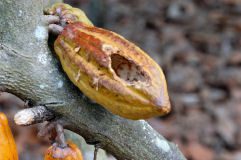
Cocoa pod after wildlife have removed the cocoa beans.

Dependence on local wildlife to open the tough cocoa pods causes its own set of problems — how to keep the animals from eating the cocoa beans. There is an easy to answer to this as well. First, the cocoa beans are covered with a tough, fibrous husk. Then the cocoa tree puts all sorts of things into the cocoa bean itself that deter animals from eating them. One of the primary substances is tannins, which make the cocoa beans when eaten fresh very astringent and not very tasty. Because of this, the wildlife will eat the sweet, delicious pulp on the outside of the cocoa beans and then spit the astringent cocoa beans themselves onto the jungle floor, where they just might find the right conditions to grow.

The tannins are not the only weapons in the cocoa tree’s arsenal. The cocoa trees also load up the cocoa beans with theobromine as well as caffeine. While we may consider both of these mild stimulants, to insects and wildlife, these can be toxic. (Theobromine is what is responsible for making chocolate toxic when ingested by dogs.)  So, the answer to the question: How much caffeine is in chocolate?” is absolutely yes. The tree depends on it.

Caffeine, it is all in the bean. Caffeine is also in your chocolate.

The cocoa bean contains between 0.1% and 0.7% caffeine, 0.2% being the most common amount found. Caffeine is also present in lesser amounts in the husk that surrounds the cocoa beans, usually from .05% to 0.3%. By way of comparison, dry tealeaves are approximately 3% caffeine, and dry coffee beans are about 1.2% caffeine (Robusta coffee has 40 to 50% more caffeine than regular coffee).

During chocolate making, the fibrous husk that surrounds each bean is removed through a process of breaking the bean into pieces, separating the husk from the bean, and then winnowing away the lighter husk from the heavier nibs by use of vacuums or high-pressure fans. The pieces of bean created during winnowing are called cocoa nibs. (The nibs are often ground up before being used to make chocolate, the result being called cocoa mass or cocoa liquor.) It is the nibs that contain the caffeine found in chocolate. The more nibs (or cocoa mass/cocoa liquor) used to make a piece of chocolate, the more caffeine it will contain.

Cocoa nibs contain approximately 54% fat, much as peanuts contain peanut oil. The fat is called cocoa butter, and it contains no caffeine. The plant material (i.e., non-fat) part of the cocoa nibs is called cocoa solids. This is where the caffeine is found. Dark chocolate is dark because it contains a larger percentage of cocoa solids than milk or white chocolate.

How much caffeine is in chocolate: Dark Chocolate

Typical Dark Chocolate Recipe

Cocoa Beans 39%
Sugar 48%
Cocoa Butter 13%
Lecithin < 1%
Vanilla < 1%

Dark chocolate contains a greater percentage of cocoa solids than does milk chocolate or white chocolate. Because of this, dark chocolate will contain more caffeine than either of these two. Dark chocolate typically contains cocoa nibs, sugar, cocoa butter, and sometimes vanilla, salt, or lecithin. Dark chocolate is made with varying percentages of cocoa bean. Chocolate is often labeled either as semi-sweet or bittersweet, terms that are not well defined, though semi-sweet is typically sweeter than bittersweet.

Because of the confusion that often occurs because of these nebulous terms, many high-end manufacturers have begun to label their chocolate with the actual percentage that comes from the cocoa bean. (It should be pointed out that many low-end chocolate manufacturers have now begun to follow suit.) This does not clarify the confusion, since cocoa butter is typically counted as part of the percentage, and some chocolate manufacturers use more or less cocoa butter than others.

For the sake of argument (and to make our calculations simple), let’s assume that the chocolate manufacturers use 10% added cocoa butter. We can then calculate the approximate amount of caffeine in one pound of dark chocolate as follows:

Chocolate Percentage mg/pound mg/3.5oz (100g) mg/2oz (56g)
43% (Semi-Sweet) 353mg 77mg 44mg
50% 453mg 99mg 57mg
60% (Bittersweet) 544mg 119mg 68mg
70% 635mg 139mg 79mg
80% 725mg 159mg 91mg
90% 816mg 179mg 102mg
100% 907mg 198mg 113mg

 It should be pointed out that almost nobody eats a whole pound of chocolate, dark or otherwise, in one sitting. There is an inverse relationship between how dark the chocolate is and how much is eaten. The darker chocolate becomes, the less people eat. This makes it difficult to correlate the percentage (how dark the chocolate is) with what people really eat.

In general, a dark chocolate bar is eaten in small pieces, not all at once. Most manufacturers of quality dark chocolate mold the chocolate with deep scores, the intent being that the chocolate be eaten in small bite-size pieces and savored. For example, our two ounce (56 gram) chocolate bars are scored into 15 pieces of equal size (.113 ounce / 3.2 grams) — the perfect size for slowly savoring one piece at a time. We expect that a chocolate bar will last far beyond a single sitting, generally several days to a week.

In the end, there is a moderate amount of caffeine in dark chocolate, not nearly as much as in coffee, and it would not be typical for someone to consume enough dark chocolate in a single sitting to equal the amount of caffeine found in a cup of coffee. The amount of caffeine actually consumed will depend on the person, the darkness of the chocolate, and the number of tasting squares the chocolate is divided into.

How much Caffeine is in Chocolate: Milk Chocolate

Typical Milk Chocolate Recipe

Cocoa Beans 16%
Whole Milk Powder 16%
Sugar 38%
Cocoa Butter 30%
Lecithin < 1%
Vanilla < 1%

Caffeine is in milk chocolate in trace amounts. However, it is not nearly as much as we have seen in dark chocolate. It is hard to quantify how much caffeine is in milk chocolate because each manufacturer has its own recipe, and the percentage of chocolate that comes from the cocoa bean varies widely from manufacturer to manufacturer. According to one study that examined the recipes used by milk chocolate manufacturers, milk chocolate was found to contain as little as 8.5% or as much as 40% of cocoa from the cocoa bean (the rest being cocoa butter, milk, sugar, and sometimes, vanilla (or vanillin), soy lecithin and salt). A typical recipe for milk chocolate uses only about 16% cocoa nibs.

If we use this as an average amount, we can calculate that one pound of milk chocolate contains 145 milligrams of caffeine. (One prominent chocolate company in the United States reports that its chocolate contains approximately 100mg of caffeine per pound of chocolate.) This is approximately the same amount of caffeine as is in one cup of coffee.

Is this a lot of caffeine? Not too many people can eat a whole pound of milk chocolate in a single sitting. If they do, then they are also eating close to a half a pound of sugar. The large amount of sugar will more than likely cause much more of a “buzz” than will the naturally occurring caffeine.

How much caffeine is in chocolate: White Chocolate

Typical White Chocolate Recipe

Cocoa Butter 27%
Sugar 48%
Milk Powder 25%
Lecithin < 1%
Vanilla < 1%

White chocolate is made from cocoa butter, milk, and sugar. Sometimes a little vanilla is added to round out the flavor. Almost all white chocolate uses deodorized cocoa butter as its main ingredient. This means that the solid portions of the cocoa bean have been removed through filtering and exposing the melted cocoa butter to hot steam. All that remains is the naturally occurring fat from the cocoa bean (cocoa butter). Since this is all that is left and there is no caffeine in milk, sugar or vanilla, for all practical purposes, caffeine is not present in white chocolate.

Conclusion

So does chocolate contain caffeine? The answer is yes. Does chocolate contain lots of caffeine? The answer is no.

Chocolate has been found to contain enough caffeine to be of concern to people with heart or other ailments. For this reason, some doctors will recommend that some people who are not in good health not eat foods that contain caffeine.

Doctors will of course recommend that people reduce or eliminate other foods from their diets if those foods are not healthful. A prime example is salt, which can cause severe problems for people with high blood pressure. If consumed in large enough quantities, salt is also capable of killing a perfectly healthy individual. And while salt can kill when consumed in large enough quantities, salt is also necessary for life.

Preliminary studies on coffee suggest that it may have some health benefits to people who suffer from Alzheimer’s, Parkinson’s disease, heart disease, and diabetes, among others. Some of these studies indicate that part of these health benefits are due to the caffeine naturally present in coffee. Whether this holds for chocolate as well has yet to be investigated, though it would be natural for some of these affects to carry over.

So, now you know the answer to: “How much caffeine is in chocolate?” So should the caffeine that is in chocolate be a concern? It probably should be if you are not healthy. Otherwise, I doubt that the amount of caffeine in chocolate is enough to affect most people unless enormous amounts of chocolate are consumed. The fact that chocolate contains caffeine is simply one of those interesting curiosities that surround what is in a lot of our food. When food is eaten in moderation it can be enormously pleasurable, and one of the most pleasurable foods to be found anywhere is chocolate.

For comparison purposes, a chart containing the amount of caffeine in various beverages is included below.

Food / Beverage Serving Size (oz) Caffeine (mg) mg/oz
Coffee
Coffee (Brewed) 8 107.5 13.44
Coffee (Decaf Instant) 8 2.5 0.31
Coffee (Decaf Brewed) 8 5.6 0.70
Coffee (Drip) 8 145 18.13
Coffee (Espresso) 1.5 77 51.33
Coffee (Instant) 8 57 7.13
Tea
Tea (Brewed) 8 47 5.88
Tea (Green) 8 25 3.13
Tea (Instant) 8 26 3.25
Tea (Lipton Brisk) 12 9 0.75
Tea (Lipton Ice Teas) 12 9 0.75
Tea (Nestea Ice Tea) 16 34 2.13
Caffeinated Sodas
Cocoa Cola Classic 12 34.5 2.83
Cocoa Cola Diet 12 45 3.75
Pepsi 12 38 3.17
Pepsi (Diet) 12 36 3.00
Dr. Pepper 12 41 3.42
Dr Pepper (Diet) 12 41 3.42
Highly Caffeinated Sodas
Bawls 10 66.7 6.67
Jolt Cola 23.5 220 9.36
Mello Yello 12 52.5 4.38
Mountain Dew 12 55 4.58
Red Bull 8.3 80 9.64
RockStar 16 160 10.00

References:

Food / Beverage Caffeine Table Data from EnergyFiend.com
Industrial Chocolate: Manufacture and Use, Third Edition. S.T. Beckett Editor.
Chocolate Production and Use. L. Russell Cook
Chocolate, Cocoa, and Confectionary: Science and Technology, Third Edition. Bernard W. Minifie
Cocoa; C.J.J. Van Hall
Cocoa and Chocolate: Their History from Plantation to Consumer; A.W. Knapp

Removing the Chaff, Winnowing Cocoa Beans

Cocoa beans on a conveyor belt in an old industrial machine.

Winnowing the Wheat from the Tares

Winnowing Cocoa Part 2

Okay, when we are dealing with cocoa beans, we aren’t dealing with wheat. However, when most people think of winnowing, the biblical reference to winnowing the wheat from the tares is the first thing that comes to mind. In ancient times, wheat would be thrown into the air on a windy day. The wind would blow away the light chaff (the paperlike coating around the wheat), and the heavier wheat would fall straight down and be caught on a mat.

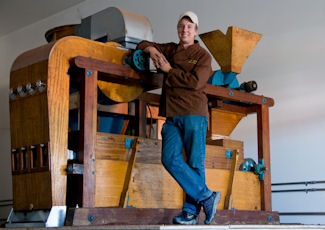
Amano’s Winnowing Machine along with Amano’s founder, Art Pollard. It was built in the 1920’s or 1930’s and refurbished at Amano’s factory.

This ancient technique is not far from that used today. The husk that surrounds the cocoa beans is as thin as paper and very light. By contrast, the cocoa bean nibs are heavy—and this is the key to separating the two. The basket that was once used in ancient times to throw wheat into the air is today replaced by a winnowing machine, and the wind of ancient times is replaced by large fans capable of creating a veritable hurricane inside the winnowing machine.

The husk and nibs drop through the airflow, and the husk is blown away like confetti, leaving the bits of bean behind. The husk is blown into a separator that separates the husk from the airflow. The husk drops into a bin and the air goes into the … air.

Winnowing cocoa beans is more difficult than winnowing wheat, however. With wheat, all the grains are almost identical in size. In fact, anciently, grains were used as measures of weight for just that reason, giving us units of weight such as “grains” and “carrots” (from carob). By contrast, when a cocoa bean is broken, it breaks into pieces of a wide variety of sizes and weights. Because of this, it is difficult to tune the airflow to blow away the husks and leave only the beans.

Without a way to properly tune the airflow, it will be either too strong and blow away most all of the husk, leaving little bean nib; or the airflow will be too low, creating a high yield of nibs but also a high percentage of husk. As one might suspect, there is a better way to winnow cocoa beans.

The trick to solving the problem is to size the nibs and pieces of husk through the use of a series of screens with holes of varying sizes. Typically between five to seven screens are used to classify the bits of husk and bean by size. When the pieces are sized in this way, it is highly unlikely that pieces of husk and bean of the same size will also be of the same approximate weight.

The bits of husk and bean flow through or across the screens and then into chutes with individually adjustable airflows. The airflow in each chute blows the husk up, and out while the cocoa nibs fall into a receptacle.

Cocoa Nibs

While the cocoa bean nibs are carted away to make chocolate, cocoa powder, and other cocoa-based products, one may wonder what happens to the husk. This has been a source for debate for well over one hundred years. In the late 1800’s and early 1900’s, it was thought that the husk would make a good additive to animal feed. Unfortunately, because of the high levels of theobromine in cocoa husk, when this was tried, the animals promptly died. While theobromine is not toxic to humans (and in fact, it helps give chocolate some of its “addictive” properties), it is poisonous to most animals, especially poultry (such as chickens). For this reason, it has found only limited use in animal feed, since it must be given only in small quantities.

Today, cocoa bean husk is sold or even given away as garden mulch. For this, the husk is highly sought after. The husk is full of nutrients and has high concentrations of nitrogen, potassium, and phosphorous—all important plant nutrients. Its strong fibers help to break up the soil, and thus it is particularly useful in soils with lots of clay. When used to cover the soil, it helps to keep the moisture in and makes a beautiful ground cover. The best part, of course, is that it makes gardens smell of chocolate. What could be better than that?

Free at Last!

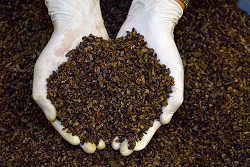
Handful of cocoa nibs ready to be made into chocolate.

After the beans have been roasted, crushed, and winnowed, the precious cocoa bean nibs are free at last of their bondage within the husk and can be used to make a whole variety of incredible delicacies. For example, they may be ground along with sugar to make chocolate, or pressed in hydraulic presses to make cocoa powder. The cocoa nibs may even be used by themselves for cooking. Cocoa nibs make wonderful chocolate chip cookies or even on a salad with orange slices and citrus vinaigrette. Most likely (and most importantly), the nibs will be used to make chocolate. If the craftsman who is working with the nibs takes care with roasting, winnowing, refining and conching, the cocoa nibs can meet their full flavor potential as part of an incredible chocolate.

Previous: <<– Removing the Chaff (Part 1)

Winnowing, a Key to Quality Chocolate

A pile of cocoa beans in a bowl next to an old grinding machine.

Winnowing Cocoa Part 1

Removing the Chaff Part 2

When people think about chocolate making, they often overlook one important step—the winnowing process. Each cocoa bean is surrounded by a fibrous husk. When the cocoa pod is on the tree, this husk serves to protect the interior of the bean from animals that may break into the pods to eat the sweet pulp that surrounds each bean. When moist, this husk is soft and pliable, but once dry, the husk forms an almost impenetrable barrier—and one that must be removed in order to make a smooth chocolate at peak flavor.

After the beans have been harvested, they are fermented, dried, then shipped to the chocolate maker. When the chocolate maker receives the cocoa beans to make into chocolate, they are very hard, and the husk adheres to the bean with an iron-tight grip.

If the husk is not removed, the remains of the fermented pulp will end up being integrated into the final chocolate, creating an “off” flavor that is not easily removed from the finished chocolate without damaging its flavor.

Unfortunately, a few chocolate makers still integrate significant amounts of husk into their final chocolate. This occurs in one of two ways. First, there are those that integrate significant amounts of chaff and hope that nobody notices. In order to cover up the off-flavors imparted by the remains of the fermented pulp as well as the husk itself, a very heavy roast is used. This helps to disguise the flavor of the pulp, but unfortunately, it also destroys many of the more subtle flavors that are part of the cocoa bean itself.

Second, since government regulations on chocolate still allow for the presence of some husk (up to 1.75%), some chocolate makers will work to ensure that the maximum allowable amount of husk remains present. While this may only be fractions of a percent, when large amounts of chocolate are concerned, the fractions of a percent add up quickly. Since the husk is essentially free, this small percentage of savings adds up, creating an enormous cost savings.

For fine chocolate, however, adulteration with cocoa husk should not even be considered. The impact on flavor is too great. Furthermore, if shortcuts are taken in this very crucial step, it is highly likely that shortcuts will also be taken on other important aspects of the chocolate making process. The result is an inferior product.

Roasting is Key

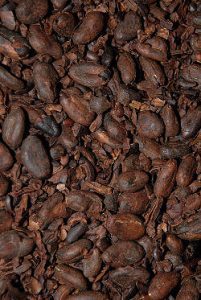
Roasted Cocoa Beans

When cocoa beans are roasted, several things happen. First, the fats in the cocoa bean husk melt. The fat that is in the husk of the cocoa bean is not the same as the cocoa butter contained in the bean, but it is closely related. After the fat in the husk melts, the cocoa butter in the bean begins to melt. The melting of the fat in the husk, as well as that in the bean, helps to loosen the husk from the bean itself. The dried cocoa beans contain about 10 percent water and this involves the final step needed to separate the husk from the bean. As the water heats, it turns to steam, and the steam rushes to the surface of the bean, blowing up the husk like a small balloon, separating the husk from the bean.

If the chocolate maker chooses whole-bean roasting, the roasting for flavor development and winnowing is one and the same. However, if the chocolate maker prefers nib-roasting for the cocoa beans, then the roasting for winnowing occurs first and is a separate process from the roasting used for flavor development. In this case, the roast for winnowing occurs at a high temperature for a short period of time. This blast of heat is enough to melt the fats in the husk and bean and to cause the water in the bean to vaporize quickly, separating the husk from the bean. The roast is not for a long enough period to start the Maillard and other reactions that are important for flavor development.

Breaking the Beans

After the roasting, the cocoa husk has separated from the bean, or at the least, it has been significantly loosened. Even so, the husk still surrounds the bean. In order to remove it, the beans must be broken. This may be done by using a series of rollers through which the beans pass. The rollers crush the beans, breaking them into pieces, along with the now brittle husk. The distance between the rollers must be tuned to allow for different sizes of beans.

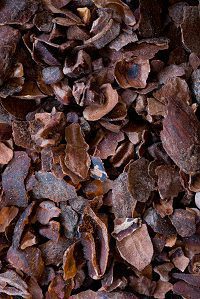
Crushed cocoa beans with husks

The primary alternative to this procedure is to drop the beans into a series of rotating blades. The blades hit the beans, breaking them, then propelling them against a steel plate, further breaking the beans into pieces. These pieces are called cocoa bean nibs. No matter which method is employed, the end result is pieces of bean mixed with pieces of broken husk. Now that the husk that once surrounded the bean been removed, the bits of husk now can be separated from the bits of bean.

Next: Winnowing the Wheat from the Tares

Delivering Chocolate to the Farmers in the Guayas River Valley, Ecuador

An image of divider backdrop, associated with Amano Artisan Chocolate.

Delivering Chocolate to the Farmers in the Guayas River Valley, Ecuador

An image of divider backdrop, associated with Amano Artisan Chocolate.

One of the greatest privilege I have is to be able to take finished chocolate back to the farmers who helped grow the cocoa that we use.

In most cocoa growing countries, it is rare for the farmers to eat chocolate made with their own beans. The hot temperatures in the tropics where cocoa is grown, combined with the remoteness of many of the cocoa-growing communities, makes it very difficult for chocolate—let alone chocolate made with a farmer’s cocoa—to reach them.

For a long time, I had wanted to make a premium chocolate from cocoa from Ecuador. This can be a difficult endeavor. Historically, Ecuador has produced some of the finest quality cocoa in the world. Unfortunately, over the last 100 years or so, the quality of Ecuador’s cocoa has suffered drastically. The move from artisanal chocolate to industrial chocolate ruled by a few large companies 100 years ago has caused the post-harvest practices in Ecuador to suffer. Farmers got used to sloppy practices that reduced the labor required to produce fine-quality cocoa beans no longer demanded by the mass-market chocolate companies.

Large chocolate companies have planted modern hybrids, most notably a variety called CCN-51, which is incapable of producing fine-quality chocolate. CCN-51 has great productivity but suffers from poor flavor. Additionally, it depletes the soil drastically, leaving farmers with unproductive soil after a few bountiful years.

Ecuador is home to a variety of cocoa called Nacional. Nacional has a deep, rich chocolate flavor but also beautiful fruity (often blackberry) overtones that are unique to cocoa from Ecuador. As a company, we have a policy of not working with CCN-51, which we consider to be a scourge of the chocolate world. So for us to create a chocolate from cocoa from Ecuador, it was important to find a place where we could be sure we would be getting Nacional and not CCN-51.

Working with a team in Ecuador, we were able to find just this. Using a set of farms that were old—very old—about an hour up river from Guayaquil. This area is home to Arriba Nacional. The story is that early cocoa traders would come to the port city of Guayaquil and ask where the best quality cocoa was. They were pointed up river with the phrase “Arriba! Arriba!” (meaning “Up! Up”). Ever since, people have referred to this particularly fine quality cocoa as “Arriba Nactional” or simply “Arriba.”

To ensure that there was no CCN-51 in the cocoa, a program was set up where the beans were not purchased from the farmers but the cocoa pods themselves. Once the beans are taken out of the pod, it is virtually impossible to visually tell the difference between CCN-51 and Nacional. The pods themselves, however, are visually much different and can be readily identified as one variety or another. This took a bit of coordination, since the farmers were used to selling the cocoa “wet” (or fresh out of the pod) and not the pods themselves. The farmers had to feel comfortable with the fact that they’d be selling pods but would be making the same amount of money as the “wet” beans they had been selling.

The flavor of the beans was phenomenal. The finished chocolate was exceptional. All in all, I was very excited about this chocolate. I decided to call it Guayas, after the Guayas River basin where this exceptional cocoa is found. As luck would have it, as the release date neared, I was contacted by friends in Ecuador wanting me to come and visit. Perfect timing!

I gathered a box of our new Guayas chocolate bars and jumped on the next flight to Ecuador. It was late at night when I arrived, and after being met by friends, I made my way to my hotel.

When it was time to head to the farms, we jumped in the car and headed out of town. As we crossed the enormous bridge spanning Guayas River, I could not help but think of the history of cocoa trading ships that had snaked their way up and down the river, visiting the various ports and traveling through the Panama Canal, then across the sea to the world’s greatest chocolate makers in Europe. This area was steeped in cocoa history, and I felt a bit like Marlo in The Heart of Darkness traveling up the river in the Congo toward ever more wild and wondrous adventures.

As we traveled from town to town, the towns became villages, the villages became communities, and the communities became random clusters of houses. We finally reached a lone dirt road that turned off on to the right toward a field that had been recently burned out. The dirt road rose 15-20 feet above the fields on either side. Clearly we were in the Guayas River floodplain, and the raised road snaked its way like a giant python through blackened field after field. Bouncing through the potholes, I watched the blackened remains of what was once crops as we left a smoky trail of billowing dust behind us.

While there was nothing left other than a few black leaves rustling in the wind, it occurred to me that this had been a sugar cane field. The long sword like leaves on sugar cane can be razor sharp, making harvesting a potentially dangerous proposition.

To make harvesting easier, sugar cane fields are routinely burned, which removes the leaves and leaves the juicy stalks behind. There are many a tale of moon-crossed lovers taking a romantic refuge in sugar cane fields for an evening romp, only to be trapped by the flames of the burning fields, their bodies to be discovered only the next day, still clutching each other, a blackened testament to their love.

We eventually came to a small group of houses sitting back from the dirt road. Like many of the houses in this region, these were up on stilts. They sat even with the road, and a network of boards stretched from house to house, and from the random house-to-dirt road upon which we rode. This small group of houses is the small village—if you can call it even that—where our cocoa comes from.

Since it wasn’t quite time for the get-together we had planned with the farmers, we stopped by one of their houses and met with the eldest farmer. Like so many of the wonderful farmers I have met on my travels, he was one of the most kind people I have known. There is something about a farmer’s heart that creates a connection with life that is almost impossible to achieve in any other way. While I do not speak Spanish, his kindness was readily apparent. He had inherited his farm from his father, and his father from his father. With pride in his eyes, he introduced me to his son, who would be taking over the farm and continuing the tradition of cocoa farming out on the Guayas River floodplain.

I asked him what he knew of the disease which some had reported had killed the Nacional that grew in Ecuador. There have been many claims by one group or another that there was no Nacional left, saying it had all died out from disease in the 1920s and had been replaced with various hybrids. I was curious what the response would be from a simple farmer who was old enough to remember, rather than from the academics who argue from their remote polished desks thousands of miles away. As can only be expected from a farmer, the answer was brilliantly simple: “Yes, we lost lots of cocoa but we didn’t lose all the trees. What do you think we replanted with?”

We toured the farm and I asked many questions, of both the father and the son, about their farm and their family history. The trees on this farm were enormous. They were very old, and while their age escapes me at the moment, these were the same trees that had passed from generation to generation, providing cocoa to the father and the father’s father. Unlike many cocoa plantations, these trees had been planted from seed rather than from grafting. When planted from seed (unlike grafting), the trees will grow very tall, which can make harvesting more difficult. (Grafted trees will grow only 10-15 feet tall vs 30-40 feet for trees planted from seed.)

We went back to the farmer’s house and spent time with his family. Their house was surrounded by coconut trees, and it wasn’t long before they found out how I love to drink the coconut water from fresh coconuts. When I used to do landscaping in Hawai’i, this was my drink of choice on a hot tropical day. They quickly scaled a tree and knocked down a few young coconuts. I took a machete and started to open one up, quickly learning how rusty my machete skills had become. After the coconuts were opened, I took a big draft from the nearest. It was very refreshing, especially as some of the water drained down my chin and onto my shirt.

It was time for the party we had planned, so we jumped back in the car and drove just a short way down the road to the end of the row of houses. There everything was ready for our party for the farmers. We had tents all set up with chairs and tables, all in the shade. The whole community was there. The communities children ran in and out among the tables and chairs while the adults kicked back under the shade of the tents, relaxing.

It was a hot and sweltering day, and the shade of the tents beckoned. As I put my things on the nearest table in the shade, there was a whiff of smoke in the air. This wasn’t the smoke of a fire in the fields that we had just passed. This was different. It was the smoke caused by something delicious over a fire. I turned and saw that the hamburger stand which had been ordered was already cooking up burgers and hotdogs for everyone. Yes, there were free hotdogs, hamburgers, and drinks for everybody.

Before things began to take on a life of their own, we gathered everybody together to sit down underneath the tent. My friends spoke to the farmers about what a wonderful thing their cocoa had become and that their cocoa was the key ingredient that made the finished chocolate so special. They continued on and talked to the group about their cocoa and their community. Since the cocoa was purchased in pods and was not “wet,” there were issues a business nature that needed to be discussed as well.

Finally, it was my turn to speak. I talked to them about how their cocoa was and is their heritage. How their cocoa has bound their community together for generations and how that cocoa has traveled the world and been with people during their most joyful times and the times they needed comfort. I talked about the need to protect their farm from contamination from CCN-51 and how planting CCN-51 was abandoning their heritage. I continued about how their cocoa was truly special and how hard it was to find truly great cocoa—and that was what their cocoa was,truly great. Despite being in a community that was far from the nearest city and in a remote part of the world, they had something truly wonderful that was not found elsewhere, and it should be treasured. I talked about how we had named the chocolate “Guayas” as a way to honor their forefathers, the country, and area where the cocoa comes from. I said more than that, but I don’t remember it all.

At the end, though, there was one thing I had to do, which, I believe, spoke volumes; and from the reaction of the people, I believe it meant far more than anything I had to say. I told them that I had brought for them chocolate made with their very own cocoa. I passed out chocolate, giving each person, including the children, a chocolate bar. Everybody was happy. Earlier, I had cut several bars into pieces, so while I handed out bars for everyone to try, everybody got to try a piece of the chocolate they helped create. There were so many people, it was difficult to make sure that everyone got a bar and a piece of chocolate.

One elderly lady, most certainly the town matriarch (whether they wanted her to or not), ruled their community through her the strength of her personality, and she knew it. She seemed particularly taken by the chocolate and was very excited when she ate it. After I finished making the rounds, everybody was told that they could go and get as many hamburgers, hotdogs, and drinks as they wanted. But before I could make my way over to the rapidly growing line (hey, I was hungry too!), this little old woman came to me and demanded “Mas!” which in Spanish means “More”! She then thrust out her gnarled, cupped hand expecting me to give her more, just as she demanded. This was not a request but a clear and simple demand. I knew I was beaten. There was no arguing. I gave her another piece of chocolate.

The smell of the hamburgers was intoxicating. I ended up being in line surrounded with young schoolgirls, who were so happy to be included in the party. The hamburgers were most tasty, nothing like them in the United States. Yes, there was the all-beef-patty and a bun, and they looked normal, but they had chopped onion for their only topping, along with some sort of sauce that I’d never had before. The flavor was indescribable, and I quickly found myself returning again and again, along with everybody else, until all the hamburgers were gone.

It was not long before I was again confronted by the community matriarch, and just like last time, she stomped in my direction, thrust her gnarled, cupped hand in my face, and demanded “Mas!” (“More!”). I gave her more chocolate, and again, she walked away satisfied.

I had a sneaking suspicion that this was not the last time I would be confronted by this woman, and I was not to be disappointed. She came back at least three more times before the party officially ended.

Once the hamburgers and hotdogs were gone, it signaled to many people that the end of the party was near. Some people drifted off. Some of the farmers stayed to talk business.

All in all, the party that launched our Guayas chocolate was a roaring success. It was not without its problems, however. There was supposed to be a band to play during the party. They apparently became lost on the way and never showed.

Despite the small hiccup of the band now showing, the party brought much happiness to the community. The smiles of the farmers and on the faces of the children made the entire trip and all the planning worth it. I was particularly pleased that the farmers were able to try chocolate made from their beans before the finished chocolate was delivered to our retailers or our customers. I’ve always believed that the farmers should come first, and this was a wonderful way to show it.

I hoped on that day that it could be a precedent for our future chocolate bars—being able to deliver the chocolate to the farmers before our customers or retailers. So far, I haven’t been able to repeat this feat. All in all, it was a series of miracles, all coming together, that allowed the timing of finished chocolate, my flight, the shortnotice scheduling of the party, to be just right. It is my hope that as time goes by, I can repeat this event and have the timing of the packaging, chocolate, and all the whirlwind of events. required to bring everybody together to launch a new chocolate all come together, so the farmers can once again be first to sample chocolate made with their very own cocoa.

Chocolate From The Region

Speaking to the Ecuadorian Congress-against CCN-51

An image of divider backdrop, associated with Amano Artisan Chocolate.

Speaking to the Ecuadorian Congress-against CCN-51

An image of divider backdrop, associated with Amano Artisan Chocolate.

Fine-quality cocoa has many challenges. It costs more, it is hard to get, and the supply is limited. However, since the 1960s, fine-quality cocoa has been under a slow and relentless barrage.

Even within the fine-chocolate community, there is nary a word about the quiet battle that good-quality chocolate makers are facing each and every day. The battle is against a variety of cocoa called CCN-51.

CCN-51 was developed by researcher Homer Castro in the 1960s. It is highly productive and very disease resistant, traits that the large chocolate companies adore. At the same time, CCN-51 doesn’t taste good, and the quality of the chocolate made from it is far inferior compared to properly fermented and dried cocoa from traditional varieties. But because of its high productivity, the industrial chocolate companies have pushed hard for its introduction in such areas as Ecuador, Peru, Columbia and Venezuela, which are the heart and soul of fine flavor cocoa.

To address these issues, I had the great opportunity and honor to be invited to speak to the Congress of Ecuador at their capitol building in Quito. They wanted to hear about the state of CCN-51 from a premium chocolate maker, and in their view Amano is one of the foremost quality chocolate makers in the world. Because of this, it was important to them to take the view from Amano into account; hopefully this would benefit them in their sales to other fine-quality chocolate makers as well.

A photo of the culprit behind the loss of an incredible amount of heirloom varieties of cocoa. Not only is CCN-51 prolific like a weed but, it is difficult to turn into good quality chocolate.

On my flight to Quito, it was amazing the number of volcanoes that I could see from the air. One volcano after another poked its way through the clouds. Ecuador has more volcanoes for its landmass than any other country on earth. In fact, Ecuador has 43 volcanoes, most of which have been active in recent memory. All I could think of as I watched them through the window as they slowly passed by was whether someday, I might be able to climb these volcanoes and see the tops of the clouds from them. It was an almost overwhelming desire and it was with sadness that I watched one after another fade as the next came into view.

When I arrived in Quito, I went directly to the hotel where I was being put up. When I walked into the lobby, I immediately realized that this was going to be a real treat. The hotel lobby was beautiful, and I could only imagine that my room was going to be equally as nice. When I’ve traveled to numerous cocoa-growing countries, quite often my accommodations are quite sparse. Having a line of ants crawling across the wall, mosquitoes buzzing about, and bug bites in the morning of unknown origin are quite the norm. This time around, however, was going to be far from that case.

A view of Quito from the air as I flew in to speak to the Ecuadorian congress about CCN-51

The room was beautiful. I knew that after a long, hard travel, I would at least in the evening be able to rest peacefully.

Quito is the only place on the equator where the altitude is so high that it can snow. Quito is situated at 9,300 feet, which is amazingly high and creates some really unpredictable weather.

Most people don’t know (but it is obvious once you see it) that Ecuador actually means “equator,” and Ecuador’s position right on the equator is where the country gets its name. I wanted to see the equator while I was there, and so we went to visit the “equator.” The equator is of course a huge tourist trap, and there is the official line where you can stand in both the northern and southern hemispheres at the same time.

A view of the lobby of my hotel when I flew to Quito to talk about protecting Ecuador’s Nacional from CCN-51

As luck would have it, a storm blew in, and once we arrived, the weather turned cold. Really, really cold. Since I was traveling to Equador, I had not bothered to bring warm weather gear, so I was shivering up my own storm in my short-sleeved t-shirt. The storm got worse and worse, and by the time I reached the official line on the equator, it was snowing—not very hard, but snowing nevertheless. It made me laugh at how I could stand on the equator while shivering in snow.

After visiting the equator, I went to lunch with some friends near the presidential palace. There was a huge military force surrounding the palace, complete with armored personnel carriers. It turned out that there had been a huge riot around the palace just two to three days before, and the military was very, very nervous about a coup attempt. I thought about trying to get my picture taken with some of the military officers, but for some reason I felt they would not think it as exciting as I did.

Lunch was delicious. One of the appetizers was puffed corn. In Ecuador, and many of the cocoa-growing countries, it is common to eat puffed corn. This is like the kernels of popcorn that puff but do not pop all the way. They are lightly salted and make a really nice crunchy appetizer or treat.

Ecuador is named after the fact that it lays on the equator. Here I am standing on both halves of the world. Of course, we all do that every day — it just depends on where you draw the line.

The next day, I was picked up by my friend Lourdes. We were running a bit late, so we zoomed through Quito. Quito is constructed on a bunch of mountain “fingers,” so there is often no way to drive from point A to point B. To go from A to B, you have to zoom in and out on the various fingers of the city, which, combined with the fact that many of the roads are one-way roads, makes getting around very complicated, and it can take much longer than planned to go anywhere.

Being late to speak to the Ecuadorian Congress would be a impolite, so we zoomed in and out of traffic as fast as we could. It wasn’t too far (as the crow flies) to the capitol building, but because it was a few “fingers” away, getting there was going to take much longer than we had hoped. We prayed as we zoomed in and out of traffic that we would not get pulled over by the police, because we were certainly breaking just about every traffic rule there was.

Finally, we arrived at the capitol building, with five minutes to spare. Unfortunately, we were still in the car zooming around the capitol, and there was not a parking space to be found. We circled and circled and circled. Every car along the road was parked bumper to bumper, and there was no sign that any cars were going to pull out. Eventually, we pulled over, talked to one of the many security guards who surrounded the building. and explained the situation. We ended up parking in the driveway that led to the dumpster, and the security guard stood watch to make sure that the trash truck didn’t come by before we came back.

We were five minutes late at this point. We sprinted around to the front of the building and quickly rushed through security, metal detectors, and whatever else had been dreamed up to make sure we weren’t troublemakers or going to state our own coup. Security pointed us up a few floors, and we jumped on the elevator and breathed a big sigh of relief.

When we exited the elevator, we were pointed to a conference room where the members of congress sat and were engaged in a big discussion. We sat down in the hallway and watched through the glass as their discussion went on and on and on. It was about forty-five minutes before we could see that discussions were wrapping up. The irony wasn’t lost on me how we had zoomed through the city breaking every traffic law imaginable, and here we were waiting and waiting.

One of the dignitaries in the room came into the hallway and waved us in. We had a quick round of discussions, in which we introduced ourselves to each member of congress and they to us. It was all very cordial. Lourdes has also fought against the ever- widening reach of CCN-51. She started off and argued for the preservation of Nacional and the complete banning of CCN-51.

Eventually, it was my turn to speak. The basic points I made before the Ecuadorian congress were these:

1) Ecuador has been legendary for the fine flavor of its cocoa. As they were aware, for hundreds of years, people have traveled to Ecuador to purchase Ecuador’s unique variety of cocoa –Nacional. I told them that Nacional has a flavor that is not found anywhere else in the world, and that it is a national treasure that is unique to Ecuador.

2) Despite what has been represented by the large chocolate companies, CCN-51 is not a fine-flavor cocoa. In fact, in my view that it can not be used to make fine-quality chocolate. The flavor of CCN-51 is simply not that good, and our opinion of CCN-51 is so low that we will not allow CCN-51 into our factory.

3) By growing CCN-51, Ecuador not competing anymore with price for Nacional, which has always commanded a nice premium, but Ecuador is competing on the world market. If someone wants the flavor of Nacional, the only way that they can get it is to buy cocoa from Ecuador. However, with CCN-51 they will be competing against everybody who plants CCN-51 throughout the world. If Africa is able to produce CCN-51 for less, people will buy their cocoa from Africa. If Indonesia is able to produce CCN-51 for less, people will buy their cocoa from Indonesia. The people who purchase CCN-51 are the same people who are not interested in flavor, and so price will be the deciding factor. On the other hand, the people who purchase Nacional traditionally are those who are more interested in flavor, and so price plays a much smaller role in the buying decision. By planting and supporting CCN-51, Ecuador is catering to a market where price is the most important factor.

4) As CCN-51 become more prominent, Ecuador faces a crisis in which its precious Nacional could be lost due to cross-pollination between native varieties and CCN-51. This loss of a national heritage literally traces way back thousands of years through the selective breeding by their forefathers.

5) CCN-51 faces the same problem that mono-cropping always does. CCN-51 plants are effectively clones, because they are spread by grafting. This means that all CCN-51 are genetically identical. Plants that are genetically identical face the problem that if a disease is capable of hurting or even killing one individual plant, this same disease is capable of killing all of the same plants with the same genetics. Ecuador had already faced a plague in the 1920s that killed off almost all of its cocoa, and planting enormous quantities of a single strain of cocoa is simply asking this to happen again, but now on a much larger scale.

This problem exists with all mono-cropping – not just CCN-51.

I concluded by requesting that they give serious consideration to any further planting of this clone. In the least, CCN-51 should be planted separately from Nacional, with an adequate buffer zone around the CCN-51 plantation so that there is lower possibility of cross pollination. I praised the flavor of the Nacional cocoa and explained that they truly have something special, and it is up to them to really let the world know what a treasure they have, and they should not let it slip away.

At this point, I broke out our Guayas chocolate and gave each member of the congress a bar so that they could taste what pure Nacional tastes like. (We go through extraordinary efforts to ensure that there is no CCN-51 in our Guayas chocolate.) I broke out another bar and then gave each member a piece. They were all very impressed and spent a large amount of time talking about how delicious it was. We took a few pictures shook hands and went our separate ways.

Lourdes and I walked out and talked about how we believed it had been a productive meeting, and those present seemed receptive to our message. We then made our way to our car in the back of the capitol building and were extremely happy that the guard was still watching over our car, which hadn’t been towed.

It is my hope that our message was indeed heard. It would truly be a shame if Ecuador’s prized cocoa Nactional were lost. It would even be worse if it were lost to a variety of cocoa that historically does not make good-quality chocolate and can be found in so many other cocoa-growing countries.

As consumers, I believe it important that we check with the chocolate makers we buy our chocolate from to see if they have any chocolate that is polluted by CCN-51, and if there is any sort of company policy about working with it. I know that at least as far as Amano is concerned, we won’t let it into our factory in any form.

It was a huge honor to be invited to speak to the Ecuadorian congress. After it was all over, I went back to my hotel and enjoyed taking a nap on my nice big soft bed.

Here I am with one of the members of the Ecuadorian Congress. Note she is holding one of Amano’s pre-release Guayas chocolate bars made with 100% Ecuadorian Nacional cocoa.

Chocolate From The Region

How I Crashed in the Dominican Republic

A crashed white pickup truck against a pole on a rural road.

I start to write this from my hospital bed in the village of San Francisco in the Dominican Republic. We buy some of our cocoa beans from this area. Yesterday, I was in a big car accident. What happened? We were run off the road by a bus.

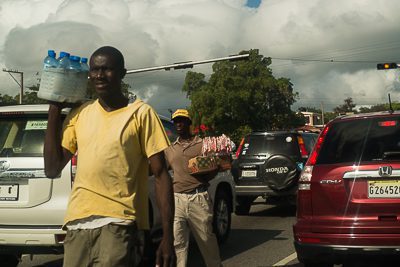
At stop lights in the Dominican Republic, it is not uncommon to be able to buy just about anything from food to electronics from the street vendors.

Driving in the Dominican Republic is always an adventure. People talk about the crazy drivers of Italy, or some European cities, but in my travels, the Dominican Republic has them all beat. I have never seen drivers like those of the Dominican Republic—anywhere!

What is it like when driving in the Dominican Republic? Crazy. At least from an American perspective.

When a car passes another car, it is not uncommon when pulling back into the lane to pull in front of the other car, leaving only two to three feet in between. This is even the case when traveling at full speed (80-100kph) on the highway.

I’ve watched people drive through intersections in Santo Domingo, interweaving traffic from different directions, missing each other by a few feet. This is the norm in many areas, and many people take this as a matter of course.

Scooters are everywhere, and it is common to see scooters with anywhere from two to four people loaded on the back, carrying groceries or even their laundry fresh pressed from the dry cleaners, flying high and holding the cleaning like a sail.

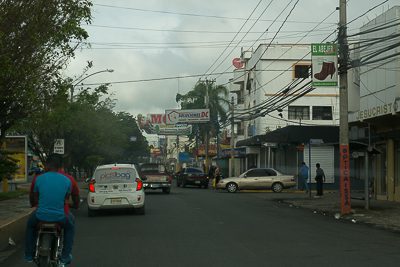
Traffic in San Francisco in the Dominican Republic not too far from the outskirts of town where we crashed.

On one trip, I watched two people on a scooter driving at least 30mph. The amazing thing was that the guy on the back was holding a five foot long tank of compressed acetylene, such as that used by oxyacetylene welders, balanced across the seat. Not only would it be dangerous if the tank were to tip but, if the valve were to be knocked off, the tank would take off like a rocket. In fact, there are plenty of stories of welders who have accidentally knocked off the valve off one of their tanks, only to have it shoot through one or more cinderblock walls. Traveling on scooters with crazy objects precariously balanced is all taken in stride in the Dominican Republic.

So what happened in my case? A driver was taking me to the village of San Francisco after I had visited the airport to try to get my luggage. (My luggage had been stuck in New York’s JFK airport and had been for several days.) It is a several hour drive from Santo Domingo to San Francisco. The drive was generally uneventful—that is, other than the usual scary things you see when you drive in the Dominican Republic.

As we pulled into the outskirts of San Francisco, a bus pulled around our truck to pass. Unfortunately, it pulled back into our lane sooner than it should have.

I watched as we pulled over toward the side of the road. Not a problem. After all, the drivers in the Dominican Republic often have to compensate for other drivers. I watched as the side of the road got closer. Not a problem. After all, once the road was clear, we’d pull back over. But then the side of the road got closer, and quite frankly, I still didn’t think much of it. I did start thinking a lot of it when we popped up onto the sidewalk, though I half expected that we would pull back into the street any moment. I was wrong. Both the edge of the road and a street sign loomed before me.

They loomed large. Very large!

The street sign stopped us about the time that my side of the vehicle went off the road and through a bunch of brush. We came to a crashing halt that left me amazed at how fast we stopped. No skidding, nothing dramatic that signaled the end of our wild ride, just an immediate and abrupt, crashing halt.

I looked down, and there was my right arm, which had been resting on the window sill, all covered with blood. It was like a dream, and I felt faint—really, really faint. As my head spun and I swooned, I looked down at amazement at my arm. I closed my hand into a fist and waited for the pain to shoot up my arm, signaling a broken bone. Nada. I slowly rotated my wrist. Nada. This only took just a few seconds, and quite frankly, it all seemed like a dream. I was amazed that while bloody, my arm was still in one piece, and everything seemed to be working just fine.

The window that had been next to my arm lay shattered. Those little glass squares that come from broken car windows lay everywhere. I looked out and saw all the brush that my side of the car had gone through, and only about one foot away was a barbed wire fence.

Later, I would realize my good fortune. If the accident had happened only a few minutes earlier, I had had my window down and was enjoying having my arm out the window in the fresh breeze. If my arm had been out when we went off the road and through the brush and next to the fence, there is no telling what the outcome would have been.

All this had all happened virtually in an instant. At least it felt that way. At the same time, it also felt like an eternity. While I was in my time warp, the rest of the world continued at normal speed, or perhaps just a bit faster. Within only about twenty seconds or so, at least fifteen people had rushed to our truck to help. It was amazing how fast the truck was surrounded by a swarm of people.

My driver climbed out, and as it turned out was relatively unscathed. Only a few seconds later it seemed like five people reached in through the driver’s side door to pull me out. Of course, it was probably only one or two, but it felt like five. They did it with amazing ease too. I was feeling very faint. The world spun. So I am glad they helped pull me out of the truck. Had they not, I probably would have stayed—at least for a while.

The truck was surrounded by people, and I made my way through the crowd until I reached the edge of the sidewalk. Feeling faint, I sat down and thought to myself how I really ought to put my head down between my knees. Then I thought, “I’ll be okay in just a second.” The next thing I knew I was flat on my back looking up at everyone. They reached down, grabbed me, and threw me into a truck. We sped toward town. I don’t speak Spanish, so all I could think of was: “I don’t speak Spanish, I have no idea where we are going or in whose truck I’m in, but, I’m bleeding, so I guess we are going to the hospital.”

We arrived at the clinic, and I was quickly rushed in. The doctors (and nurses) set to work immediately, and in short order, they had pulled lots of glass out of my arm and were busy stitching me back up. The doctor handled it very professionally, and he and I chatted while he did his job. (He had attended medical school in the Dominican Republic btw.) Each jab of the doctor’s needle shot my arm with a new sense of pain, but in comparison to how my arm already felt, it was a small thing to consider, and as the anesthetic took hold, the pain slowly subsided.

When they were done, I asked them to count the number of stitches that I had.  They counted 18.

Then they did something very unexpected. They took me in for an ultrasound. (Was I expecting?)

My ultrasound was followed up by an X-ray of my arm. When they were done, they said they wanted me to stay overnight for observation, so they took me up the elevator to the floor I would be staying on—which turned out to be a storage room as well as an elevator. My room was off a waiting room off the hallway. (Yea, it was just a bit out of the way.) They fumbled through all the doors and wheeled me into my room. The TV was blaring, some sort of reality TV show. I settled in and waited… And waited and waited…

Youtube Video Link missing (“video of me going to my hospital room”)

My friend from the cocoa plantations I was working with brought over my laptop, my phone, and a few things I needed. While he was away, I spent some time giving thought to how to tell my wife. After all, I had been through a serious accident in a foreign country, one she had never been to. If I worried her too much, it could be difficult to go on my various adventures again. Once I got my phone, I called home, and my wife handled the news surprisingly well, all things considered. I was amazed.

I settled in and watched “Game of Thrones,” which I had preloaded on my laptop before I left. Nothing like binge-watching—episode after episode of whatever television show is available.

It was a long night. Nurses were pumping me full of fluids through an IV. The amazing thing was that they didn’t have me on an electronic monitor. Well, that isn’t exactly amazing; those cost lots of money. The amazing thing was that they wanted me to stay overnight for observation, but there was not much going on to observe.

With car accidents, it is quite common for people to get traumatic head injuries that appear superficial at first but turn out to be quite dangerous and deadly in the long haul. My brother and I were first upon an accident in which the driver had fallen asleep. The driver appeared just fine immediately after the accident, but by the time the ambulance arrived, the driver was dazed and confused, unable to follow simple instructions. My brother Chris said that he likely had a hematoma, and if not treated quickly, he would likely pass away. (He should know; he was the head safety engineer for the West Coast for the ambulance conglomerate American Medical Response.)

So having a bit of a personal experience with these sorts of things—if only in passing–I spent the night watching Game of Thrones until it was very late, and I became convinced I was tired—because I was was tired, but not because of any sort of injury that had gone undiagnosed.

The whole night, they only checked on me only three or four times. Each time, they checked my IV but didn’t check my vitals. I was nervous that they weren’t observing. After all, that was the whole point of my staying in the clinic overnight. I could be dead and cold by the time they found me if something went terribly wrong. If they wanted to observe, I would have felt a lot more comfortable if I would have been left in the hall.

In the morning, I awoke, and I believe I woke up alive. To this day, nobody has told me different. So I’m alive as far as I know.

The doctor wasn’t happy that I planned on going back to the cocoa plantations. She was very concerned that I would get dirt and bacteria in the wounds, and they would become infected. The Dominican Republic is a tropical country, after all; all the added humidity and heat are a great growing environment for all sorts of nasty bacteria that could make me sick. (I received a similar set of worries from one of my friends in the chocolate industry who urged me in no uncertain terms to catch the next flight out.)

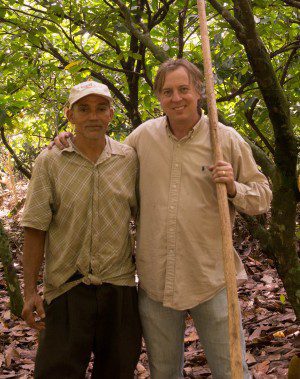
Amano’s founder and chocolate maker Art Pollard with a cocoa farmer in the Dominican Republic two days after his car accident.

I spent a day resting in my room where I had been staying and being loaded up with 600mg of Ibuprofen, as well as a handful of antibiotics. The Ibuprofen was less for the pain and more for the inflammation (which in itself causes pain), and the antibiotics helped me prevent any infections.

The next day, I was back out on the plantations and able to work with the farmers I have come to know and hold dear. It was a beautiful day, and the blue sky and cool breeze testified to me that I was in the right place doing the right thing.

Each day my arm got better and better, and each day for the rest of my trip I was able to spend time on the cocoa plantations. I found that hot showers helped bring flexibility back into my arm, and after about three weeks (which is when I finished writing this up—from my room in Tokyo), my arm was significantly better, with the exception of some bright red marks that spiderweb the backside of my arm and elbow and will no doubt turn into scars to testify of my adventures in the Dominican Republic.

A friend of mine in the DR once told me a story about her friend who moved to New York.

She went to the Department of Motor Vehicles to apply for a driver’s license. She sat down in the car with the instructor to take her driving test.

As they began their test, the instructor looked at her and said, “It looks like you have driven before.”

“Yes,” she said.

The instructor looked at her and asked, “Where did you drive?”

“The Dominican Republic.”

“You had a driver’s license in the Dominican Republic?!”

“Yes.”

Then her instructor continued, “I’m tired and I want to go home. If you can drive in the Dominican Republic, you can drive anywhere.”

And with that, the instructor signed her driver’s license test and left for home.

So she passed her test without ever taking it simply because she can drive in the Dominican Republic and arrive alive.

Before I sign off, I’d like to say a public “Thank You!” to my friends and hosts in the Dominican Republic who cared for me and watched after me in this way way too adventurous trip.