The Origins and Flavors of Chocolate: Exploring the World’s Best Chocolate-Producing Regions

Hands holding a heap of dried cocoa beans, displaying their rough, textured surface. The scene conveys a sense of care and craftsmanship.

The Origins and Flavors of Chocolate: Exploring the World’s Best Chocolate-Producing Regions

So Where Does Chocolate Come From?


Chocolate is a treat loved by people all over the world. But have you ever stopped to wonder where it comes from? Chocolate has a rich history, with roots in Central and South America dating back thousands of years. Today, chocolate is enjoyed worldwide, with many different countries contributing their unique flavors and styles. But what country has the best chocolate? The answer to this question can be somewhat subjective, as different people have different preferences when it comes to chocolate flavors and styles. In this blog, we will explore the origins of chocolate and the differences between some of the world’s most famous chocolate-producing regions to help you decide for yourself who has the best chocolate.

Hands holding baked cocoa beans

The chocolate-making process starts with the cocoa tree, which produces cocoa pods filled with cocoa beans. The beans are then harvested, fermented, and dried to develop their flavor. After that, the beans are roasted to bring out their unique flavor characteristics, and then they are cracked and winnowed to remove the outer shell. The resulting cocoa nibs are then ground into a paste called chocolate liquor, which is then further refined to create smooth and creamy chocolate. Depending on the desired end product, ingredients like sugar, milk, and additional flavorings can be added to the chocolate. Finally, the chocolate is tempered to give it a shiny appearance and a smooth texture. The entire process can take several days and requires skill and precision to ensure the flavors of the cocoa beans are showcased in the final product.

One important factor in the flavor of chocolate is the origin of the cocoa beans. Different regions of the world produce cocoa beans with unique flavors and characteristics, which create chocolates with distinct tastes. Single-origin chocolate bars have become popular in recent years, as they showcase the flavors of cocoa beans from a particular region without any added ingredients. Cocoa is a highly diverse crop with several different varieties that have unique characteristics, including flavor, that are worth exploring. The primary varieties of cocoa are Criollo, Trinitario, Forastero, and Nacional. While each region of the world may have a distinct makeup of cocoa variety, many farms have a blend of these varieties, contributing to the overall distinct nature of cocoa from these unique farms. The rarity of certain varieties, such as Criollo and Nacional, makes them highly sought after in the industry. Neighboring valleys can have different characteristics due to factors such as fermentation, which plays a crucial role in the outcome of the flavor. As a result, even farms located in the same region can produce cocoa with vastly different flavor profiles. Our chocolate here at Amano does not use Forastero cocoa, but primarily uses Trinitario, Criollo, and Nacional instead.

Exploring the Distinctive Origin Profiles of Madagascar, Venezuela, Dominican Republic, and Ecuador.


For example, Madagascar’s unique climate and soil conditions contribute to the distinct flavor profile of its cocoa beans. The country’s cocoa farmers use traditional farming techniques and carefully tend to their crops to produce high-quality beans. The island off the coast of Africa is home to a unique variety of cocoa beans, known for their fruity and tangy flavor profile. Madagascar Chocolate often has notes of red fruit, citrus, and even a hint of tobacco. Chocolate from this origin and from Trinitario cocoa can be tasted with our Sambriano Valley Madagascar chocolate bar.

Another country that is famous for its chocolate is Venezuela. The country produces cocoa beans with a distinct nutty flavor that pairs well with the sweetness of chocolate. The beans are grown in the country’s lush forests, which provide ideal growing conditions, and the farmers take great care in harvesting and processing the beans to ensure their quality. Venezuelan chocolate is often described as having a complex flavor profile, with notes of nuts, berries, and even a hint of coffee. Venezuela Chocolate’s unique flavor profile makes it highly versatile and the ideal ingredient for pairing with a variety of flavors, such as fruits, nuts, and spices. Tasting Amano’s delicious Venezuelan chocolate from Criollo Cocoa is easy with our Ocumare Village Venezuela and Cuyagua Venezuela chocolate bars. A field of cacao plants with a tarp covering the plants.

The Dominican Republic is also known for producing high-quality chocolate, particularly dark chocolate. Today, the country is one of the world’s largest producers of organic cocoa, with many small-scale farmers still using traditional methods of cultivation. The country’s cocoa beans have a slightly bitter taste that pairs well with the sweetness of chocolate. Dominican Republic dark chocolate is often described as having a strong cocoa flavor, with notes of roasted nuts and a slightly spicy finish. Amano Artisan Chocolates showcases these flavors with its Macoris Dominican Republic and Dos Rios chocolate bars sourced from Trinitario cocoa.

In Ecuador, the country’s diverse geography and climate have led to the development of a wide variety of cocoa bean varieties, each with its own distinct flavor profile. The country’s cocoa beans are known for their earthy and floral flavor profile that leaves Ecuador dark chocolate with notes of red fruit and honey. Ecuadorian chocolate is often described as having a smooth and creamy texture, with a rich flavor that is not too sweet. Amano Artisan Chocolates offers a delicious Ecuador Guayas River Basin chocolate bar that highlights the unique flavor profile of this origin and Nacional cocoa.


The Role of Terroir and Artisanal Methods in Crafting Amano Artisan Chocolates.


Terroir is a concept in agriculture that refers to the environmental factors that influence the growth and characteristics of a crop. In the context of chocolate, terroir plays a crucial role in determining the unique flavor profile of cocoa beans. The climate, soil, altitude, and other environmental factors of a particular region where the cocoa is grown affect the beans’ development, resulting in distinct flavors and aromas. Different regions of the world produce cocoa beans with distinct terroirs, leading to a variety of flavors in chocolate.cacao pods cut open showing the seeds inside.

In addition to terroir, other factors that can affect the flavor of chocolate include the processing methods used to transform the cocoa beans into chocolate, and the added ingredients used to flavor the chocolate. Amano Artisan Chocolates takes great care in every step of the chocolate-making process to ensure that the flavors of the cocoa beans shine through in the final product. Our chocolate is made with only the highest quality ingredients and the most artisanal methods, resulting in a truly unique and flavorful experience.

Chocolate is a complex and fascinating food with a rich history and culture. The flavor of chocolate can vary greatly depending on where the cocoa beans are grown, making each chocolate bar a unique experience. Regions like Madagascar, Venezuela, the Dominican Republic, and Ecuador have all contributed to the world of chocolate with their distinct flavor profiles and high-quality cocoa beans. Whether you prefer fruity and tangy chocolate or earthy and floral chocolate, Amano Artisan Chocolates offers a variety of delicious chocolate bars made from cocoa beans from all over the world, including single-origin chocolate bars that showcase the unique flavors of each region. So why not try something new and experience the world of chocolate like never before?

Cuyagua: Art’s Most Memorable Chocolate Experience

An image of divider backdrop, associated with Amano Artisan Chocolate.

Cuyagua: Art’s Most Memorable Chocolate Experience

An image of divider backdrop, associated with Amano Artisan Chocolate.

One of the things I have always found most wonderful about chocolate is how unlike it is from so many other foods: it reaches in and touches a person’s soul. Few foods do that, and none that I’m aware of do so so completely.

Because of this, I have had some incredible experiences. People of all walks of life tell me what a profound impact our chocolate has had on them and how much they love that experience. (or love the chocolate?) The same goes for some well-known chefs whom I have admired from afar for years. It is easy to forget how, after the chocolate is made, it has a life of its own to the retailer and then to the final person who enjoys it in the intimacy of the home or a fine restaurant.

So my most precious memories center around learning how our chocolate has touched other people’s lives. One experience stands above all others, and I will never, ever forget it. Even after a number of years have passed, I still become emotional when I tell the story.

The third bar we ever made was with some very special beans from the Cuyagua Valley in Venezuela. I was only able to secure nine bags of cocoa, and so we did not have any margin for error; we had to get the production right the very first time. My business partner, Clark, and I tasted the beans and talked for a while about the flavors found in them and what each of us perceived as the strengths and weaknesses of the bean and where we thought the final chocolate should end up. We dived right in and started roasting these wonderful beans.

The result was spectacular–in fact, mind-blowing. Both Clark and I loved the end result. Our customers loved it too, and despite its higher price, it quickly became our most popular bar.

Not long after, I scheduled a trip to Venezuela and made a point of planning a trip to Cuyagua so that I could share the finished chocolate with the farmers.

Cuyagua, a small village on the Carribean coast, is nestled in a little valley quite far from any major (or minor) city. It can be a real adventure to get there. You have to climb a steep one-lane mountain road. On the downhill side, the mountain drops off, and if your vehicle goes off the edge, it will be a few hundred feet before any trees catch you. There are no guard rails. The road winds its way to the top of the mountain pass, hair-pin turns all the way. When you go around corners, you have to honk your horn to let any oncoming traffic know you are there.

When there are no clouds and you can see through the trees, the view from the top is spectacular. When there are clouds, well … you are driving in fog. The other side is not quite as perilous but still quite dangerous. Eventually, you drop into the colonial village of Ocumare, where we also get some of our cocoa. (Ocumare is a nice little village, and the hotels there are — well, rustic.)

On this trip, I stayed in Ocumare and got up at four the next morning. I drove to Cuyagua along the narrow coastal road that connects these two villages, arriving at Cuyagua at the moment of an exquisite sunrise over the Caribbean. Not long thereafter, I was greeted by Felix, who managed the plantation. We waded across the Cuyagua river and then made our way to the plantation itself.

I spent the day working with the farmers, watching them care for the trees. It was clear that for them, their job was far more than simply a way to earn a living; they truly loved what they did.

The cocoa trees in Cuyagua are beautiful. They are grown from seed and are not pruned, as many cocoa trees are. This allows the trees to grow to their full, magnificent height. Many of the trees are over 20 feet tall, and some over 30. The multi-colored cocoa pods growing from the sides of the trees and branches only add to the mystique. If there were a Garden of Eden, I have a hard time seeing how it would be much different from a cocoa plantation.

Here I am with Felix, bright and early in the morning.

One of the farmers in Cuyagua. The cigar? That is to keep the mosquitos away.

When the deeply satisfying day’s work was done, the farmers and I waded through the Cuyagua River once again to a clearing. There, I had the opportunity to talk to them about the importance of what they were doing and to tell them how special their trees are. Then I gave each famer a bar we had made from their cocoa, bars that I had carefully kept cool my entire trip. They were incredibly happy. Next, I broke off a square from an extra bar so that each farmer might taste it right then. They had never before tasted chocolate made exclusively with their beans, and the wonder in their eyes was amazing.

The highlight of the whole experience for me was when one old farmer came up and said: “This chocolate is like a river.” Thinking it an odd comment, I asked him what he meant by it. He said, “This chocolate takes you on a journey. Its flavor takes you to all the wild and wonderous places, and it goes on and on — like a river.”

His simple testimonial floored me. Here in this tiny community so far from “civilization” was a farmer who was, in his heart, a poet. Somehow, our chocolate spoke to him and touched his soul, not in a superficial way, but deep down in a profound way I had not expected.

I will never forget that day with the humble farmers of Cuyagua. Somehow, magically, our chocolate touched a simple farmer poet’s soul, and he, through his purity of heart and the clarity of his vision, touched mine.

Here I am with the farmers of Cuyagua. The poet-farmer is the second from the left.

Chocolate From The Region

Drug Lords? What Drug Lords?

An image of divider backdrop, associated with Amano Artisan Chocolate.

Drug Lords? What Drug Lords?

An image of divider backdrop, associated with Amano Artisan Chocolate.

In the United States, what crosses many people’s minds when they think of South and Central America is that it’s home to drug lords: visions of great big haciendas with enormous spreads of land perfectly manicured, guards dotting the landscape, armed to the teeth with machine guns, waiting for an armed encounter with the Federales or with the US DEA.

Of course, like many of stereotypes, the truth is far different from what we imagine. Instead of luxurious haciendas dotting the landscape, paid for and fueled by cocaine, the landscape is instead dotted by subsistence farmers who have very little in the way of resources, education, or the things that most of us westerners hold in great esteem. While poor, these farmers are often rich in family, friends, and sense of community. In fact, they are truly rich in the things that matter and the very bonds that we seem to forget in our busy day-to-day lives.

While in Venezuela, I had the opportunity to visit a very good friend of mine and to see his plantations. He is an eighth-generation cocoa farmer. Truly his heritage is cocoa; he cares deeply for what his trees, his workers, and the quality of the cocoa he produces.

After a long day visiting his various plantations, we drove to the nearest town with a hotel. It was a long drive. We followed along a very narrow, very windy road. It was all jungle on both sides of the car, so as we drove, I could not help but think what an adventure it would be to get out of the car and with nothing but a machete in hand and a leather wide-brimmed hat to disappear in the jungle like the explorers of old. (And who knows, in a pinch a giant bullwhip might even prove useful?)

Venezuelan fruit vendor

After a long day visiting his various plantations, we drove to the nearest town with a hotel. It was a long drive. We followed along a very narrow, very windy road. It was all jungle on both sides of the car, so as we drove, I could not help but think what an adventure it would be to get out of the car and with nothing but a machete in hand and a leather wide-brimmed hat to disappear in the jungle like the explorers of old. (And who knows, in a pinch a giant bullwhip might even prove useful?)

One of my traveling companions was having a hard time as we drove, however. The road was way too windy, and it was causing him to become carsick. I was not feeling particularly well myself, but as we weaved through the jungle, it felt like we were on a never-ending roller coaster at Disneyland, going up, down, around, back, and then up and down, only to weave back and forth once again. This wild ride continued for what must have been over an hour.

After our heads were all spinning from the ups, downs, and arounds, we finally reached the little village where we were going to be staying. We were relieved. That is, relieved for only a moment.

Hanging out with my friend Juan.

The entire town was deserted. There were no cars, there were no people, there were no animals. All was deathly silent. I imagined the music from a Sergio Leone spaghetti western playing in the background as we drove through town with nobody in sight.

Every once in a while, we would see a solitary person walking in the middle of the street. They walked aimlessly, almost zombie like. We all had the same thought at once: “This town must be controlled by the drug lords.” We talked about it, and we were, I have to admit, a bit afraid.

We were really afraid as we reached our hotel. There were all the people from the entire town standing aimlessly in front of our hotel, all packed together, and it wasn’t readily apparent why they were there or what they were doing. They were in fact doing absolutely nothing.

It looked just like a scene from a movie where a mob is building, getting ready to take out the embassy. And just like a scene from a movie, as we drove up to the crowd, the sea of people slowly parted. We couldn’t see where we were going, since all we could see in front, on the sides, and behind were people. We were blind. I half expected to see bricks start flying through the windows and for the mob to descend on us, tearing us limb from limb.

The door on my friend’s storage shed. Sometimes even a door can be beautiful.

Then in an instant, we were through.

We left the crowd behind us and pulled into the hotel’s parking lot. The hotel was beautiful, for being in such an out-of-the way location. It was right on the ocean shore, painted white, a bit reminiscent of a white Greek island villa but not as elegant.

As far as I could tell, we were the hotel’s only guests. We checked in and put our things in our rooms.

Once we were all checked in, we asked the question that was burning in our minds: “What is going on?”

When we found out, we laughed. As it turned out, the entire town was having a street party. The deserted streets, the few wandering aimlessly, the mob just outside our hotel—it all made perfect sense. We had it wrong: the town wasn’t run by drug lords, we simply showed up when the entire town was standing around and waiting for the street party to begin.

It was just getting dark, and I had promised my wife that I would give her a call as often as I could. As you might expect, there was no cell phone service. We made some inquiries and were told to go up to the church and stand on the rock.

We drove to the church, and sure enough, there was a rock right next to it. We discovered that if you stood on the rock, you could get just the faintest cell phone signal. If you stepped off the rock, the signal would disappear. If you stood on your tip-toes, the signal strength would get stronger. So I called home standing on my tip-toes, stretching high as best I could and trying not to fall off.

After we had each made our calls home, we went back to the hotel, chatted until all hours, and called it a night. At 4:30 the next morning, my ride came to pick me up. I gathered my gear, and off we went back to the plantations on the same crazy, windy road that we had arrived on. Of course it was different this time. It was dark and we could not see any farther than the headlights could throw a beam, which, given the windy road, was not far at all. This time I knew what to expect. Even so, winding through the narrow road in the dark was a bit of an experience.

Just as the sun began to turn the sky a beautiful pink and illuminate the clouds overhead, we arrived at my friend’s cocoa plantation. One of his workers greeted us, and he and I headed out into the cocoa plantations so that I could inspect the trees and make an assessment of what varieties were there and the potential for using the beans from these plantations.

My friend’s worker was armed with a shotgun. Clearly, being out on the plantations being generally safe was not completely the case. As we walked around the plantations, he carried the gun with the casual ease that only comes from practice.

Carrying firearms as a matter of course is common in many Central and South American countries—no matter what the laws may specify. Much of the population (and especially the farmers in cocoa growing areas) live in remote areas, and reliance on the police to solve problems is fraught with difficulties, especially when getting a police officer may take anywhere from hours to a good portion of a day. As you can imagine, by the time the officers arrive, the problem will have likely resolved itself—and not always in the farmers’ or their family’s favor.

Cocoa plantations are always a magical and beautiful place in the early mornings. They are especially peaceful and serene before the morning sun rises. In the tropics, the morning birds greet the morning with even more exuberance than they do elsewhere. This particular morning was no exception.

My bodyguard who kept me safe while visiting my friend’s cocoa plantations.

Cocoa plantations are always a magical and beautiful place in the early mornings. They are especially peaceful and serene before the morning sun rises. In the tropics, the morning birds greet the morning with even more exuberance than they do elsewhere. This particular morning was no exception.

As I’m on the cocoa plantations, I try to always look at things with a fresh eye. It is amazing what you can see if you don’t take this incredible experience for granted.

There was a tree with an amazing set of cocoa flowers. Cocoa flowers are very small (only about the size of a penny), yet they are beautiful. I always wish there were some way to grow cocoa flowers the size of a regular flower. If so, perhaps people could appreciate the beauty as I do.

A little farther on in the plantation, a swarm of enormous ants was attacking one tree’s cocoa pod. They love the juices that flow out of an injured cocoa pod. As they eat their way across the pod, they create a track that, once healed, leaves a scar. Many mature pods have track marks that testify to earlier attacks during their development. I managed to get an excellent photo of this particular attack and have often wondered if this particular pod managed to survive until the harvest season.

These cocoa flowers are really only about the size of a penny. They are in my opinion one of the world’s most beautiful flowers.

Later, once the sun was fully out, I walked back to my friend’s greenhouses, where he grows baby cocoa trees. These he uses for his own plantations, as well as providing them to other farmers who will grow the cocoa for my friend to buy later. While there, I managed to grab a few black and white photos shot in infrared.

Infrared photographs are made by using a filter that blocks all visible light and only lets infrared light through. Infrared light cannot be seen by the human eye but can be felt as it is the infrared we feel as the sun’s heat on a beautiful summer day. With infrared, plants turn white and the sky turns black, making each and every infrared photograph an adventure, since the camera in this case sees the world quite a bit differently than does the human eye.

These were my very first infrared photographs, and they introduced me to a new area of photography that I have enjoyed pursuing ever since.

Later that day, I hooked up with my friends who came to the plantation to meet me. They chose to sleep in, and while I’m sure they were able to enjoy a wonderful rest, they also missed out on a truly magical morning.

This cocoa pod is being attacked by ants. They will leave a huge web of scars on the grown pod.

As it turns out, I learned later that our initial impressions were actually correct. The town where we had been staying was in fact in control of the local drug lords. Our fears, however, were misguided. Because of the drug lords, we were in fact perfectly safe, perhaps more safe than just about anywhere else we could be.

Why? The reason is surprising. What it comes down to is this: The last thing the drug lords need or want is government attention. In this town (and presumably similar towns), there is no crime. Crime brings attention, and attention brings the Federales (national police). As you may imagine, Federales create a host of problems for the drug lords’ trade.

When a crime is committed, it is typically handled quietly and efficiently. The criminal (not the drug lord) is taken into the jungle and the problem dealt with. The problem disappears. Not surprisingly, people stay on their best behavior.

The last thing they needed was for a few Gringos to turn up missing, or other problems that would cause the Federales to come and start asking questions.

I will never forget this crazy experience. A wild rollercoaster ride, a ride through a town that was somewhere between a Sergio Leone/Clint Eastwood spaghetti western and Night of the Living Dead, balancing precariously on tip-toe on top of a rock to call home while stretching skyward, one of the most beautiful mornings I have ever experienced on a cocoa plantation, and finally the discovery that we had been the unwitting guests of the local drug lords. What more could one ask for on a cocoa-hunting expedition?

When I started Amano, I knew it was going to be one wild ride and the opportunity to meet some wonderful people and have some amazing experiences. Since then, there has been no shortage of such experiences, no way that I would have had it otherwise. Even so, some days stand out more than others, and these wild twenty-four hours were certainly some of the most memorable hours ever.

Eating Italian in the Dominican Republic? (Or, how I fell in love…)

An image of divider backdrop, associated with Amano Artisan Chocolate.

Eating Italian in the Dominican Republic? (Or, how I fell in love…)

An image of divider backdrop, associated with Amano Artisan Chocolate.

The Dominican Republic is host to some of the finest quality cocoa in the world.

It is mostly all trinitario, a variety or hybrid that originated in Trinidad. It is speculated that it is created from Venezuelan “Criollo” and “Forestero,” which originated in the upper Amazon basin. These two came together after what they called a “blast” (probably a giant storm, but it could have been disease) hit Trinidad in 1727 and killed off most of the original cocoa in Trinidad (Venezuelan criollo). The new hybrid was more disease hardy and also had some beautiful fruit flavor notes as well as some deeper chocolate flavor notes.

Today, Trinitario has spread throughout the Caribbean and has found a strong home in the Dominican Republic, where in many areas growing Trinitario cocoa has gone from a subsistence crop to a true art form.

The first time I visited the Dominican Republic on one of my cocoa-hunting expeditions, I had an amazing time. My hosts took me to visit a huge number of farms and operations around the island. After our first long, hard, grueling day, we started heading back to the Dominican Republic’s capital city, Santo Domingo.

About half way back to Santo Domingo, I was asked, “What would you like to have for dinner?”

For me, the answer was clearly obvious. I replied, “Let’s go eat Dominican!”

“Trinitario” cocoa pods on a cocoa plantation in the Dominican Republic.

Big long pause …

My Hosts: “Are you sure?”

Me: “Yeah, Dominican sounds excellent!”

Another Big long pause …

My Hosts: “Umm…. What do you think Dominican food is?”

Me: “Oh, I don’t know. I’d guess it is probably fried plantains, rice with some chicken on it, and perhaps some sort of gravy on top.”

My Hosts: “Yeah, that’s Dominican food, all right.”

Another big long pause …

My Hosts: “Are you sure?”

A Real Puzzled Me: “Yeah! Sounds great!”

Another big long pause… This time from me.

A Real Suspicious Me: “Why? What does everyone else eat?”

No big long pause this time. In fact, a real quick reply.

My Hosts: “Oh, everyone goes out to eat Italian! But we can take you to go eat Dominican if you like.”

So we went to a beautiful restaurant that was right on the ocean. It had outdoor seating, and we ate an incredible Dominican smorgasbord of food. There was a Dominican sampler, and that is exactly what we ordered. The next thing we knew our table was filled with an incredible amount of delicious meats, rice, vegetables and … soup.

I fell in love. With soup.

If there is a national soup of the Dominican Republic, it would have to be this very soup. In fact, it probably is. It is called sancocho. Sancocho is found throughout Puerto Rico, Columbia, and the Dominican Republic. Each country has its own unique spin on this traditional stew. It is rich and hardy and full of meat, starches (yams, and casava), and spices. Oh… especially those spices. Especially oregano and cumin. Lots and lots of oregano and cumin. The flavor is amazing—deep, rich, and very hardy in a way that you know it will stick with you for the rest of the day. Oh, all that oregano? It makes the soup look a bit on an army green side.

The entire meal was amazing. When I think of some of the finest meals have had in my life, this would have to be right up there. The food was all very simple—no Michelin Star chef to prepare it. It was simple comfort food prepared very, very well by someone who truly cared about what they were creating. When I went back to my hotel that evening, I had a very happy tummy. I slept well too.

Every time I think back on that trip, I laugh. I laugh that the world’s greatest chocolate makers from Europe—many of whom now are friends and colleagues—fly to the Dominican Republic to eat … Italian. Every time I travel to a country, I try to eat the local food as much as I can. I love trying new and exciting flavors and dishes. It’s amazing how often I find foods that are simply incredible. Occasionally, I’ll find foods that are very disagreeable, sometimes even wildly so. This is all part of the adventure that is … chocolate.

Sancocho in the Dominican Republic. One of my all-time favorite soups and a popular Dominican comfort food.


Chocolate From The Region

How I Crashed in the Dominican Republic

A crashed white pickup truck against a pole on a rural road.

I start to write this from my hospital bed in the village of San Francisco in the Dominican Republic. We buy some of our cocoa beans from this area. Yesterday, I was in a big car accident. What happened? We were run off the road by a bus.

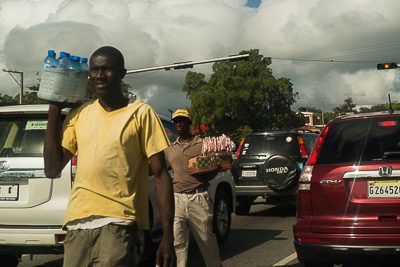
At stop lights in the Dominican Republic, it is not uncommon to be able to buy just about anything from food to electronics from the street vendors.

Driving in the Dominican Republic is always an adventure. People talk about the crazy drivers of Italy, or some European cities, but in my travels, the Dominican Republic has them all beat. I have never seen drivers like those of the Dominican Republic—anywhere!

What is it like when driving in the Dominican Republic? Crazy. At least from an American perspective.

When a car passes another car, it is not uncommon when pulling back into the lane to pull in front of the other car, leaving only two to three feet in between. This is even the case when traveling at full speed (80-100kph) on the highway.

I’ve watched people drive through intersections in Santo Domingo, interweaving traffic from different directions, missing each other by a few feet. This is the norm in many areas, and many people take this as a matter of course.

Scooters are everywhere, and it is common to see scooters with anywhere from two to four people loaded on the back, carrying groceries or even their laundry fresh pressed from the dry cleaners, flying high and holding the cleaning like a sail.

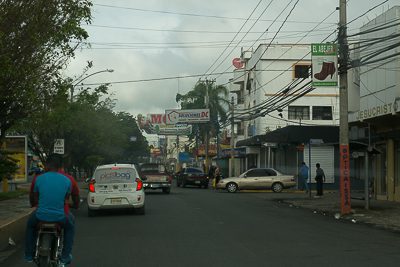
Traffic in San Francisco in the Dominican Republic not too far from the outskirts of town where we crashed.

On one trip, I watched two people on a scooter driving at least 30mph. The amazing thing was that the guy on the back was holding a five foot long tank of compressed acetylene, such as that used by oxyacetylene welders, balanced across the seat. Not only would it be dangerous if the tank were to tip but, if the valve were to be knocked off, the tank would take off like a rocket. In fact, there are plenty of stories of welders who have accidentally knocked off the valve off one of their tanks, only to have it shoot through one or more cinderblock walls. Traveling on scooters with crazy objects precariously balanced is all taken in stride in the Dominican Republic.

So what happened in my case? A driver was taking me to the village of San Francisco after I had visited the airport to try to get my luggage. (My luggage had been stuck in New York’s JFK airport and had been for several days.) It is a several hour drive from Santo Domingo to San Francisco. The drive was generally uneventful—that is, other than the usual scary things you see when you drive in the Dominican Republic.

As we pulled into the outskirts of San Francisco, a bus pulled around our truck to pass. Unfortunately, it pulled back into our lane sooner than it should have.

I watched as we pulled over toward the side of the road. Not a problem. After all, the drivers in the Dominican Republic often have to compensate for other drivers. I watched as the side of the road got closer. Not a problem. After all, once the road was clear, we’d pull back over. But then the side of the road got closer, and quite frankly, I still didn’t think much of it. I did start thinking a lot of it when we popped up onto the sidewalk, though I half expected that we would pull back into the street any moment. I was wrong. Both the edge of the road and a street sign loomed before me.

They loomed large. Very large!

The street sign stopped us about the time that my side of the vehicle went off the road and through a bunch of brush. We came to a crashing halt that left me amazed at how fast we stopped. No skidding, nothing dramatic that signaled the end of our wild ride, just an immediate and abrupt, crashing halt.

I looked down, and there was my right arm, which had been resting on the window sill, all covered with blood. It was like a dream, and I felt faint—really, really faint. As my head spun and I swooned, I looked down at amazement at my arm. I closed my hand into a fist and waited for the pain to shoot up my arm, signaling a broken bone. Nada. I slowly rotated my wrist. Nada. This only took just a few seconds, and quite frankly, it all seemed like a dream. I was amazed that while bloody, my arm was still in one piece, and everything seemed to be working just fine.

The window that had been next to my arm lay shattered. Those little glass squares that come from broken car windows lay everywhere. I looked out and saw all the brush that my side of the car had gone through, and only about one foot away was a barbed wire fence.

Later, I would realize my good fortune. If the accident had happened only a few minutes earlier, I had had my window down and was enjoying having my arm out the window in the fresh breeze. If my arm had been out when we went off the road and through the brush and next to the fence, there is no telling what the outcome would have been.

All this had all happened virtually in an instant. At least it felt that way. At the same time, it also felt like an eternity. While I was in my time warp, the rest of the world continued at normal speed, or perhaps just a bit faster. Within only about twenty seconds or so, at least fifteen people had rushed to our truck to help. It was amazing how fast the truck was surrounded by a swarm of people.

My driver climbed out, and as it turned out was relatively unscathed. Only a few seconds later it seemed like five people reached in through the driver’s side door to pull me out. Of course, it was probably only one or two, but it felt like five. They did it with amazing ease too. I was feeling very faint. The world spun. So I am glad they helped pull me out of the truck. Had they not, I probably would have stayed—at least for a while.

The truck was surrounded by people, and I made my way through the crowd until I reached the edge of the sidewalk. Feeling faint, I sat down and thought to myself how I really ought to put my head down between my knees. Then I thought, “I’ll be okay in just a second.” The next thing I knew I was flat on my back looking up at everyone. They reached down, grabbed me, and threw me into a truck. We sped toward town. I don’t speak Spanish, so all I could think of was: “I don’t speak Spanish, I have no idea where we are going or in whose truck I’m in, but, I’m bleeding, so I guess we are going to the hospital.”

We arrived at the clinic, and I was quickly rushed in. The doctors (and nurses) set to work immediately, and in short order, they had pulled lots of glass out of my arm and were busy stitching me back up. The doctor handled it very professionally, and he and I chatted while he did his job. (He had attended medical school in the Dominican Republic btw.) Each jab of the doctor’s needle shot my arm with a new sense of pain, but in comparison to how my arm already felt, it was a small thing to consider, and as the anesthetic took hold, the pain slowly subsided.

When they were done, I asked them to count the number of stitches that I had.  They counted 18.

Then they did something very unexpected. They took me in for an ultrasound. (Was I expecting?)

My ultrasound was followed up by an X-ray of my arm. When they were done, they said they wanted me to stay overnight for observation, so they took me up the elevator to the floor I would be staying on—which turned out to be a storage room as well as an elevator. My room was off a waiting room off the hallway. (Yea, it was just a bit out of the way.) They fumbled through all the doors and wheeled me into my room. The TV was blaring, some sort of reality TV show. I settled in and waited… And waited and waited…

Youtube Video Link missing (“video of me going to my hospital room”)

My friend from the cocoa plantations I was working with brought over my laptop, my phone, and a few things I needed. While he was away, I spent some time giving thought to how to tell my wife. After all, I had been through a serious accident in a foreign country, one she had never been to. If I worried her too much, it could be difficult to go on my various adventures again. Once I got my phone, I called home, and my wife handled the news surprisingly well, all things considered. I was amazed.

I settled in and watched “Game of Thrones,” which I had preloaded on my laptop before I left. Nothing like binge-watching—episode after episode of whatever television show is available.

It was a long night. Nurses were pumping me full of fluids through an IV. The amazing thing was that they didn’t have me on an electronic monitor. Well, that isn’t exactly amazing; those cost lots of money. The amazing thing was that they wanted me to stay overnight for observation, but there was not much going on to observe.

With car accidents, it is quite common for people to get traumatic head injuries that appear superficial at first but turn out to be quite dangerous and deadly in the long haul. My brother and I were first upon an accident in which the driver had fallen asleep. The driver appeared just fine immediately after the accident, but by the time the ambulance arrived, the driver was dazed and confused, unable to follow simple instructions. My brother Chris said that he likely had a hematoma, and if not treated quickly, he would likely pass away. (He should know; he was the head safety engineer for the West Coast for the ambulance conglomerate American Medical Response.)

So having a bit of a personal experience with these sorts of things—if only in passing–I spent the night watching Game of Thrones until it was very late, and I became convinced I was tired—because I was was tired, but not because of any sort of injury that had gone undiagnosed.

The whole night, they only checked on me only three or four times. Each time, they checked my IV but didn’t check my vitals. I was nervous that they weren’t observing. After all, that was the whole point of my staying in the clinic overnight. I could be dead and cold by the time they found me if something went terribly wrong. If they wanted to observe, I would have felt a lot more comfortable if I would have been left in the hall.

In the morning, I awoke, and I believe I woke up alive. To this day, nobody has told me different. So I’m alive as far as I know.

The doctor wasn’t happy that I planned on going back to the cocoa plantations. She was very concerned that I would get dirt and bacteria in the wounds, and they would become infected. The Dominican Republic is a tropical country, after all; all the added humidity and heat are a great growing environment for all sorts of nasty bacteria that could make me sick. (I received a similar set of worries from one of my friends in the chocolate industry who urged me in no uncertain terms to catch the next flight out.)

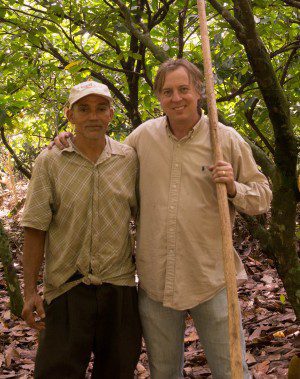
Amano’s founder and chocolate maker Art Pollard with a cocoa farmer in the Dominican Republic two days after his car accident.

I spent a day resting in my room where I had been staying and being loaded up with 600mg of Ibuprofen, as well as a handful of antibiotics. The Ibuprofen was less for the pain and more for the inflammation (which in itself causes pain), and the antibiotics helped me prevent any infections.

The next day, I was back out on the plantations and able to work with the farmers I have come to know and hold dear. It was a beautiful day, and the blue sky and cool breeze testified to me that I was in the right place doing the right thing.

Each day my arm got better and better, and each day for the rest of my trip I was able to spend time on the cocoa plantations. I found that hot showers helped bring flexibility back into my arm, and after about three weeks (which is when I finished writing this up—from my room in Tokyo), my arm was significantly better, with the exception of some bright red marks that spiderweb the backside of my arm and elbow and will no doubt turn into scars to testify of my adventures in the Dominican Republic.

A friend of mine in the DR once told me a story about her friend who moved to New York.

She went to the Department of Motor Vehicles to apply for a driver’s license. She sat down in the car with the instructor to take her driving test.

As they began their test, the instructor looked at her and said, “It looks like you have driven before.”

“Yes,” she said.

The instructor looked at her and asked, “Where did you drive?”

“The Dominican Republic.”

“You had a driver’s license in the Dominican Republic?!”

“Yes.”

Then her instructor continued, “I’m tired and I want to go home. If you can drive in the Dominican Republic, you can drive anywhere.”

And with that, the instructor signed her driver’s license test and left for home.

So she passed her test without ever taking it simply because she can drive in the Dominican Republic and arrive alive.

Before I sign off, I’d like to say a public “Thank You!” to my friends and hosts in the Dominican Republic who cared for me and watched after me in this way way too adventurous trip.